ARTS / ENTERTAINMENT / SPORTS
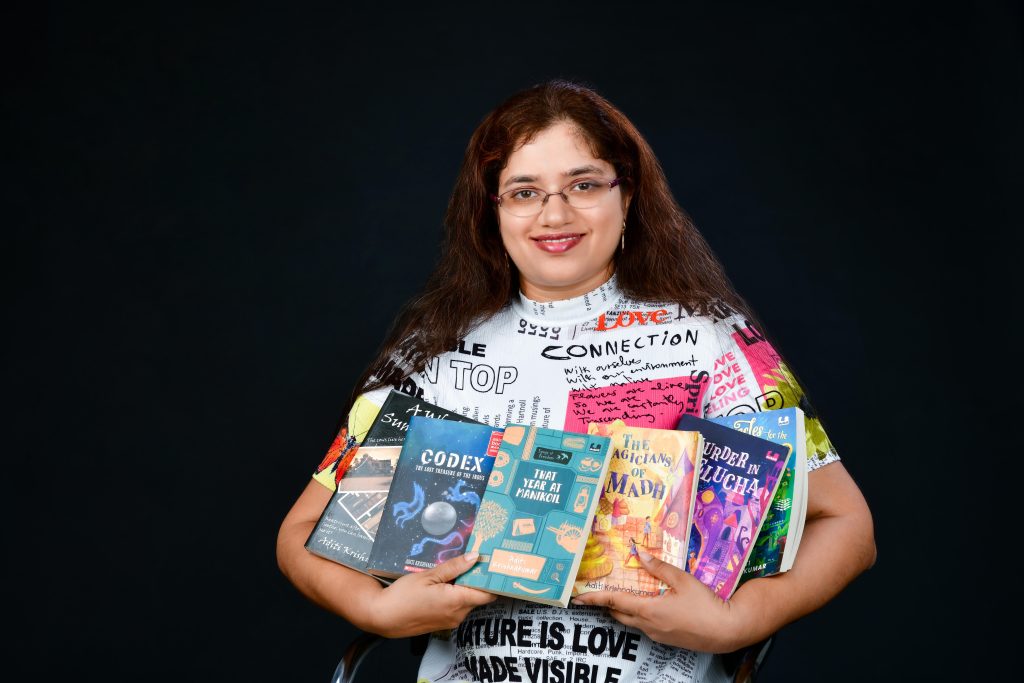
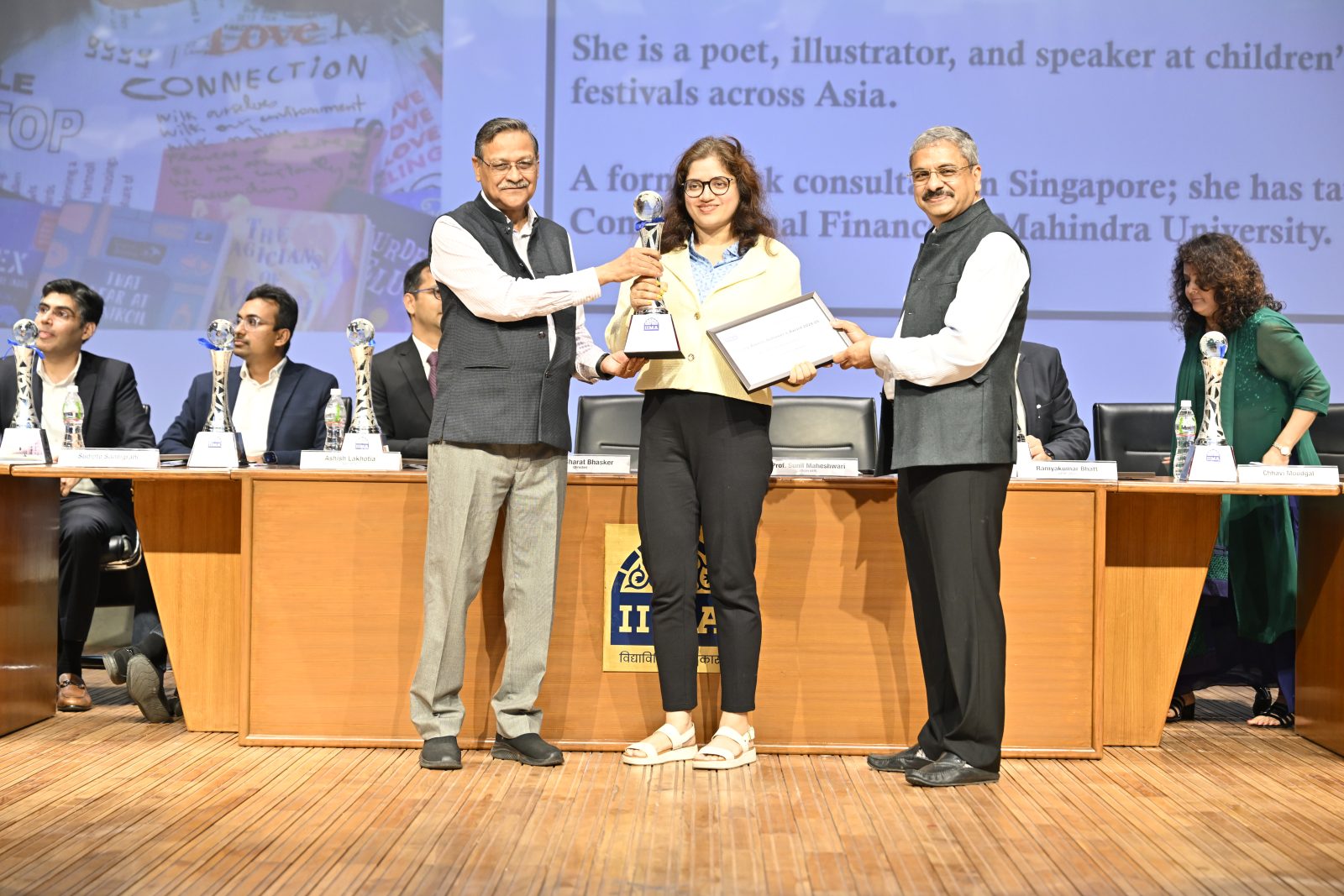
Aditi Krishnakumar is a writer, mathematician and private consultant. She’s written seven books, including Codex: The Lost Treasure of the Indus, which won the Scholastic Asian Book Award and was nominated for the Singapore Book Award. She has also been nominated for the Asian Scientist Writing Prize, the Binod Kanoria Award for Children’s Literature, and the Peek-a-Book Children’s Literature Festival Award. Aditi’s most recent book, The White Lotus, was released earlier this year to positive reviews. She has published poetry in the journals Nightingale and Sparrow and The Pangolin Review. She has also illustrated one book for children.
Ms Aditi has been a speaker at the Asian Festival of Children’s Content (AFCC) in Singapore, Kala Ghoda Festival of the Arts in Mumbai, Matrubhumi International Festival of Letters in Thiruvananthapuram, Scindia Literary Fest in Gwalior, Chandigarh Children’s Literature Festival, and Kukdukoo Fest in Hyderabad.
As a mathematician, Ms Aditi’s main research interest is Combinatorics. She has co-authored three papers in the field of Graph Theory, published in highly-regarded journals such as the Bulletin of the Australian Mathematical Society and Discussiones Mathematicae Graph Theory. She has given talks on Graph Theory at the Open University (UK) Mathematics Colloquia and the Indonesia-Japan Conference on Discrete and Computational Geometry, Graphs and Games. Her Erdős number is 3.
Ms Aditi’s work as a private consultant combines her two main interests–corporate communications and quantitative finance. She has taught Computational Finance as visiting faculty at Mahindra University in Hyderabad. Prior to that, she spent ten years in Singapore, where she worked in the field of financial risk management while keeping up her writing. She has also worked with Edelweiss Financial Services in India, doing quant, research and financial risk management.
In her free time, Ms Aditi enjoys reading, painting, and learning to play the piano.
Congratulations Aditi on winning the award. How does it feel to be recognised by IIMA for this award?
It is an incredible feeling. No matter how many years you have been away and how far you have been, there’s always something special about being recognised by the alma mater. And of course, the other thing is that, as a writer, you don’t necessarily get a whole lot of other signs that you are doing well, in an external sense. So it’s great to have this.
You have successfully transitioned from a management graduate to an acclaimed author. So what interested you in pursuing writing?
I was always interested in writing. Unfortunately, it’s the thing that doesn’t pay the bills. That’s one of the areas where I think IIMA also gives you a lot of push, because there were plenty of professors while I was here and after, who believe in making sure that you pursue your passions in addition to everything else you do. So I had lots of encouragement from them, encouragement from my family, to make it work, to keep trying. So I think that’s the thing. It’s not a question of, not initially at least, you completely give up on one thing and do the other thing, but you just kind of keep doing what you love and making time for the things you love. I think that’s the important.
People tend to think it’s odd, but I feel like literature and maths are kind of the same thing; with both of them, you are trying to understand the world around you. Literature usually tries to understand people. And with maths, you are trying to understand the nature of reality.
As a mathematician, you have co-authored three papers in graph theory published in highly regarded journals. So what fascinates you about maths?
This is it’s something I say a lot, and people tend to think it’s odd, but I feel like literature and maths are kind of the same thing; with both of them, you are trying to understand the world around you. Literature usually tries to understand people. And with maths, you are trying to understand the nature of reality. But it’s just a question of wanting to have answers. What happens? Why does it happen? And you approach it in different ways, using different methods. But they are both the same thing, and they come from a place of interest, of curiosity, of wanting to know why things happen.
You have studied math, physics, computer science, law, management, and then are now working in corporate communication and quantitative finance. So, how do you manage all these multiple interests and strengths?
So there are two things. One thing is, is that you don’t necessarily, you know, do everything in equal amounts, all the time. So let’s say, in a 2-3 year period, you have studied some degree, and then you have been working at a job, and you have written a book, and you may have done something else, but that doesn’t mean that 25% of your waking hours every day, you were able to devote to each of those things. So at any given time, there are times when you know you are really busy and you are working late hours, you are getting home at 10 o’clock, and then there are times when it’s relaxed and you go home early. The same thing happens with books. There’s a stage when you are writing or editing madly, and then there’s a stage when you take a bit of a back seat, and you are focused more on sales and everything. So at any point, I think it’s just a question of knowing what it is that needs to be a priority then, and being able to shift priorities, you know, as through the months, through the weeks and that’s something that, again, IIMA really teaches you, because while you’re here, there are so many things for students to do other than academics. There is so much going on always, and just being able to know what needs to take priority and needs to take up most of your time at any you know, on any given day, and being able to make that happen is, is how you keep that balance.
Can you share the challenges that you faced when you wanted to establish yourself as a writer?
So there are a couple of things. One thing, especially when I first started writing, is that it was hard to find a publisher. I think perhaps that’s less of a challenge now, because there are a lot more opportunities, a lot more independent publishing houses, and of course, there’s self-publishing and Kindle Direct Publishing. So actually getting a book out there is possible for everyone. With my first book, it was with a smaller publisher. So then there was the question of distribution: are we able to get the books to all the stores? I am saying this knowing that for management students, there’s definitely something that is that’s going to be important because we study all that logistics and operations and all those kinds of things. So when you’re self-publishing, or publishing, perhaps with a smaller indie publisher. These are questions that become big, like, how are you doing all this stuff? And larger publishers will have a great distribution network, traditional publishers. But both ways, it is then a question of, how do you get the book out to people? Because again, I forget the statistic, but there’s something about, how many new books are published on Amazon every day? And it’s some completely insane number. So when there’s so much to choose from. So many more people are reading and have access to online stores. And earlier, like, if you wanted a book, you had to go to the bookstore, and then if they didn’t have it, you would have to go to another bookstore and wait for them to order it. People have access, which is great, but at the same time, there are just so many choices that it becomes a question of, how do you make sure people know about your book, and for me, honestly, despite IIMA and everything, I was not great at marketing, I have tried to become better. But, you know, there’s still a long way ahead, but that is still one of my biggest challenges. Just how do you make sure that people know that this book exists, and you know you could read it, you could try it.
The thing is, I would not want to give the sort of advice that goes like, drop everything and write books or give up and do a full time job, because I think that is very dependent on people’s circumstances, on what they want out of life and what responsibilities they have, what they are able to do at any given time. But what I would say is, don’t ever believe that you can’t do it, or you’re being held back from it.
What advice would you give to somebody who’s interested in pursuing, say, writing or any other creative passion?
I would say, of course, go for it. The thing is, I would not want to give the sort of advice that goes like, drop everything and write books or give up and do a full time job, because I think that is very dependent on people’s circumstances, on what they want out of life and what responsibilities they have, what they are able to do at any given time. But what I would say is, don’t ever believe that you can’t do it, or you’re being held back from it. There may be a time a year or two, because as I said earlier, it’s not like you can devote 25% of every day to each of the things you like. In fact, White Lotus, my latest book I wrote that after a year and a half of literally not having the time to write anything. So that can happen, life might take over. You might get incredibly busy, but you will always, ultimately have the bandwidth to do the things you want to do. And the other thing that happens is–we spoke about growing up when you come here and for all creative pursuits, that’s something that I learned when I first came here. One thing is sort of the craft, you know, like learning the technical details of dance or knowing how to do different forms of poetry or singing. So that’s one part of it. The other part is, you know, the maturity and life experience that really puts depth into any creative work. So even when you’re dealing with the hard parts of life, you are gaining that maturity that is then going to make your next creative work even better. And I think that’s something important to remember.
Watch on YouTube: https://youtu.be/0y23TDjuw3U?si=ylmvED9Cc30SJ0qv