
The story of the PGP ’76 Golden Reunion in January earlier this year, in which 85-plus of our 130 contactable classmates participated along with more than 70 spouses and family members in tow, is a good story in itself and was published in the February 2026 issue of THE WIMWIAN.
But it becomes more complete once we mention that our batch also went looking for 50 faculty members from our campus years, 1974–76, and in doing so, got a reunion of sorts for them as well.
The idea was not complicated. We are what we are because of the Faculty. The Campus, the LKP, the Harvard Steps, the Retreat, the red bricks: all of it mattered, and matters still. But at the centre of it were the men and women who shaped us, one gruelling case discussion at a time. It seemed only fair that fifty years on, we say so.
The effort came together in three events.
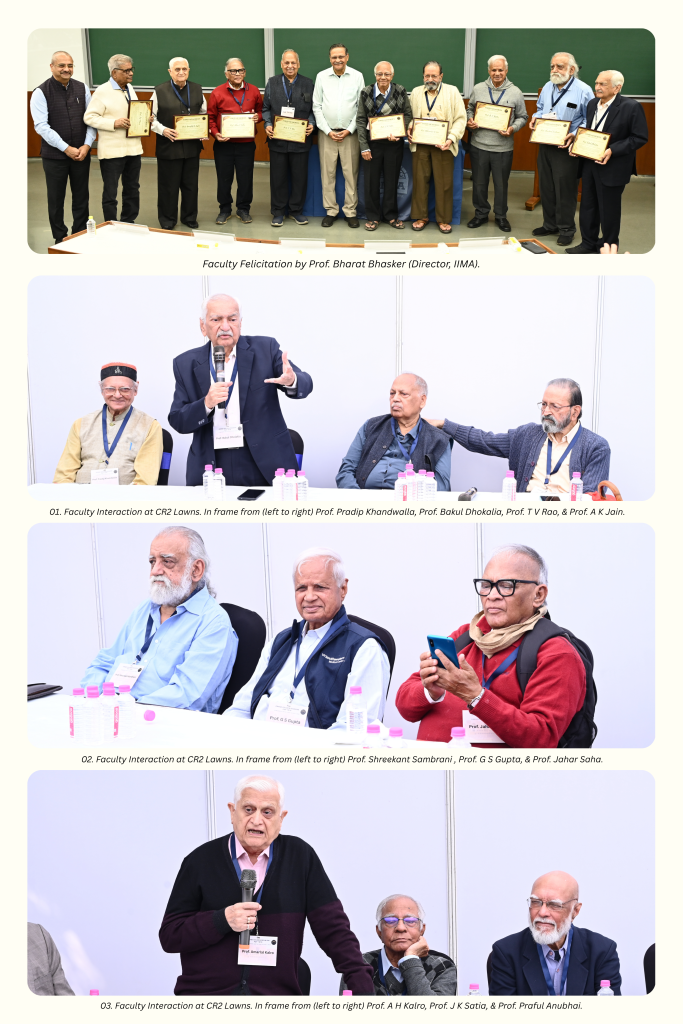
- IIMA Director’s function: More than 10 faculty members from our time joined the Golden Reunion on January 30, 2026, and were honoured by IIMA Director Dr. Bharat Bhasker, alongside our own Felicitation. Those who made it to campus included:
- Bakul Dholakia
- A H Kalro
- Shreekant Sambrani
- Jahar Saha (with spouse)
- T V Rao
- Prafull Anubhai (partially)
- Abhinandan Kr Jain
- J K Satia
- Pradip Khandwalla (partially)
- Sasi Misra
- G S Gupta
2. Faculty and PGP’76 Interaction: The faculty members held sessions with our batchmates on campus, part nostalgia and part update, trading stories of the 1970s for accounts of everything that had happened to them since. This session was completely designed and orchestrated by our batchmate Sushil Vachani. Three shamianas were set up on the CR2 lawns, and 3-4 faculty in each of these enclosures interacted with about 30 PGP ‘76 students. These sessions were pure fun, as you can see in the picture below.
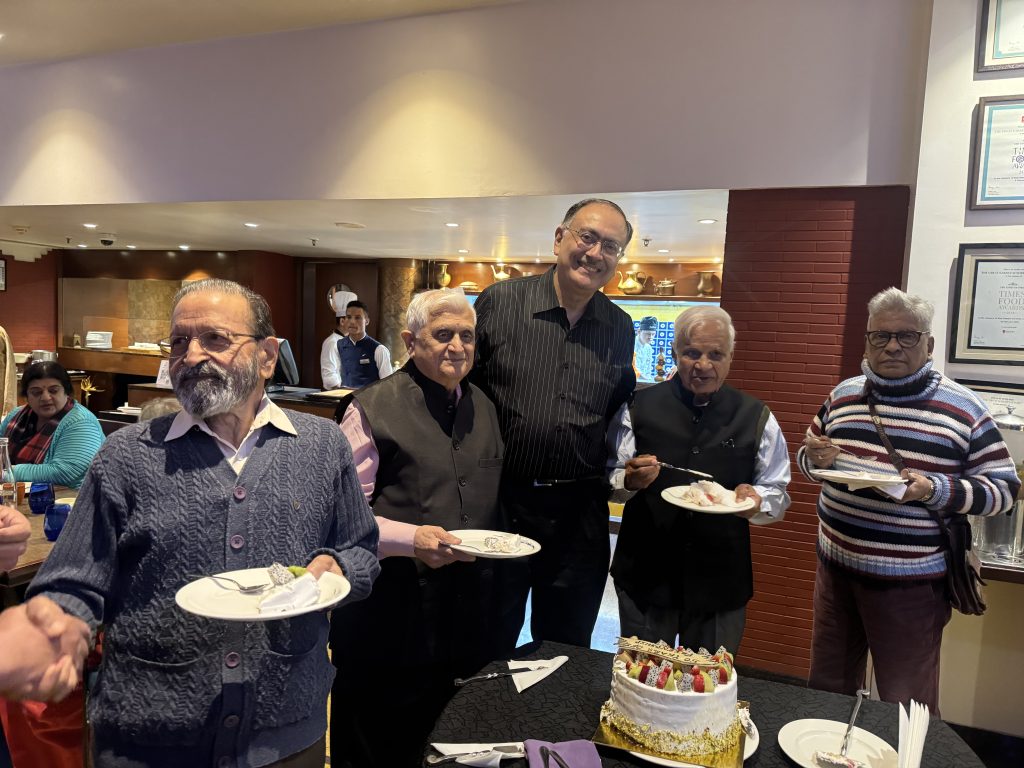
3. Informal dinner before the official Reunion: Several Ahmedabad-based faculty joined a special pre-Reunion dinner, hosted by our batchmate Abhaya Jain at Hotel Radisson, for the PGP ’76 crowd and the local faculty, on the evening before the main events.
The Process:
It will not seem obvious, but this Guru Dakshina planning was a twelve-month effort, running from January through December 2025. It started, as these things often do, with a casual conversation. Raman mentioned to the then Dean (AER), Prof. Sunil Maheshwari, that we’d like to reach out to the faculty of our time for our Golden Reunion.
Dean Sunil was enthusiastic and extremely helpful. Contact details began trickling in from him and from Institute records. A few faculty members were already known to some of us. Even so, progress was slow.
The real breakthrough arrived, as breakthroughs sometimes do, from an unexpected direction. Prof T V Rao mentioned to Raman about a WhatsApp group called the “Bratpack,” formed by the children of faculty who had been on campus in the 1970s. Raman swung into action on this lead and, with help from this group coordinated by Anagat Pareek, the Reunion Committee and all classmates, names started arriving in earnest, and within a few months our list had grown past thirty.
Meanwhile, Rajiv Inamdar, another of the organizing committee members, went to work on IIMA’s Annual Reports for 1974–75 and 1975–76 (both available on the Institute website) and patiently extracted the names that we had missed.
The eight-member Reunion Committee, working in parallel, debated how best to honour the faculty and settled on something simple: a Memento easy enough to send, carry and keep.
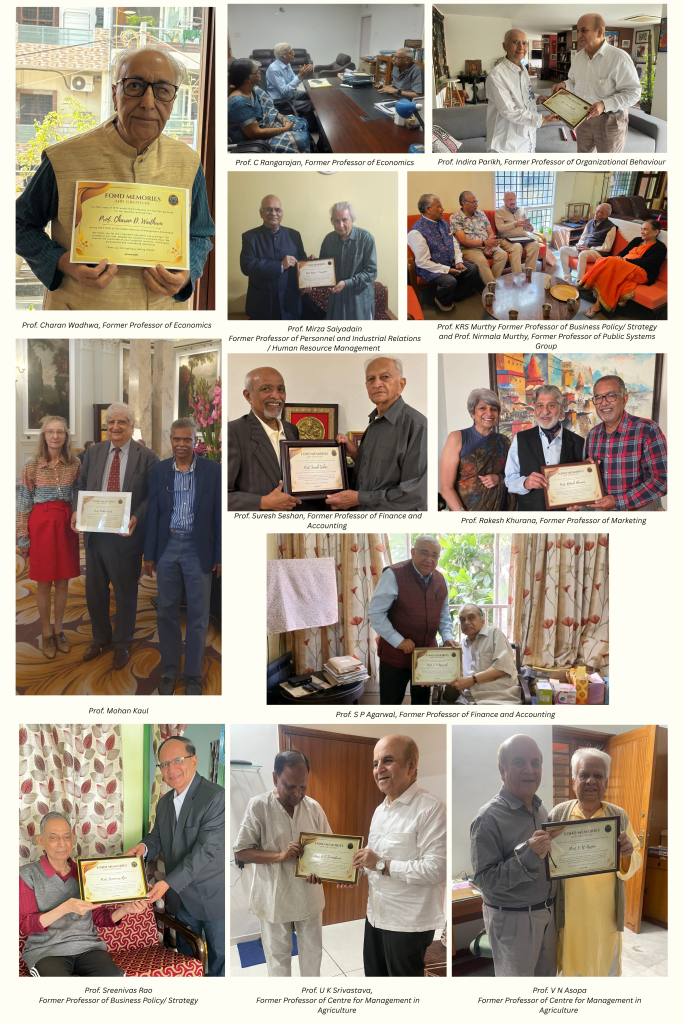
This quickly became a rather large undertaking. From Lucknow, Bengaluru, Chennai, Hyderabad, Mumbai, Pune, London and the US, batchmates went looking for their old professors and handed over the framed mementoes in person. I don’t know when, but somewhere in the process, this stopped being a project and became something closer to a pilgrimage.
We met with Prof Indira Parikh, Dr C Rangarajan (at his office), Prof V N Asopa, Prof Rakesh Khurana, Prof U K Srivastava, Prof Suresh Seshan, Prof Sreenivas Rao, Prof S P Agrawal, Prof Mirza Saiyadain, Prof K R S Murthy, Prof Nirmala Murthy and Prof Mohan Kaul. Recognising here our PGP76 buddies who did the honours-Amal Dhru, Athmanathan, Natarajan, Karti and Rajiv Inamdar, TJ Jacob, Gautam Chakravarti, Alok Ranjan, Vijayakumar, AR Ghanshyam, Jayakumar and Vijay Vanbakkam.
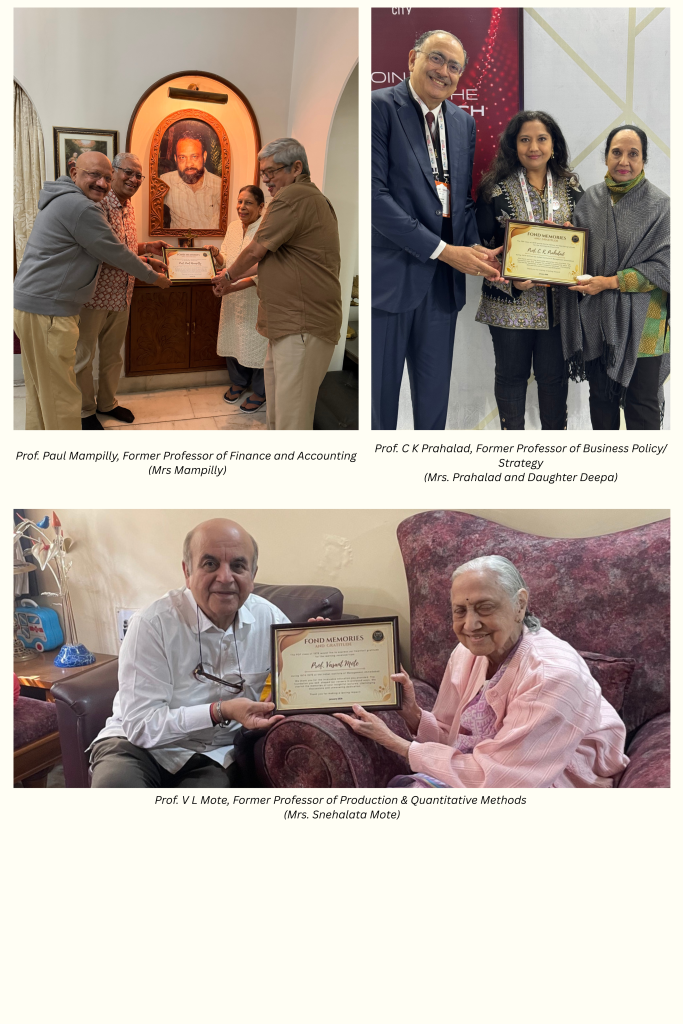
The next step mattered just as much. In cases where a faculty member had passed away, we made a point of meeting their spouse. This is how we came to honour Prof Paul Mampilly and Prof V L Mote, meeting their spouses in Bengaluru and Ahmedabad respectively, thanks to MSA Kumar, Vijay Kumar, Jayakumar and Amal Dhru. Raman similarly met with Mrs C K Prahalad and their daughter Dr Deepa at the TiE Global Summit in Jaipur and honoured them.
Where a face-to-face meeting simply wasn’t possible, we sent a scanned copy of the memento by email, with our respects. This covered Prof Charan Wadhwa, Prof John Camillus, Prof Nitin Patel, Prof Subhash Bhatnagar and Prof Nik Dholakia.
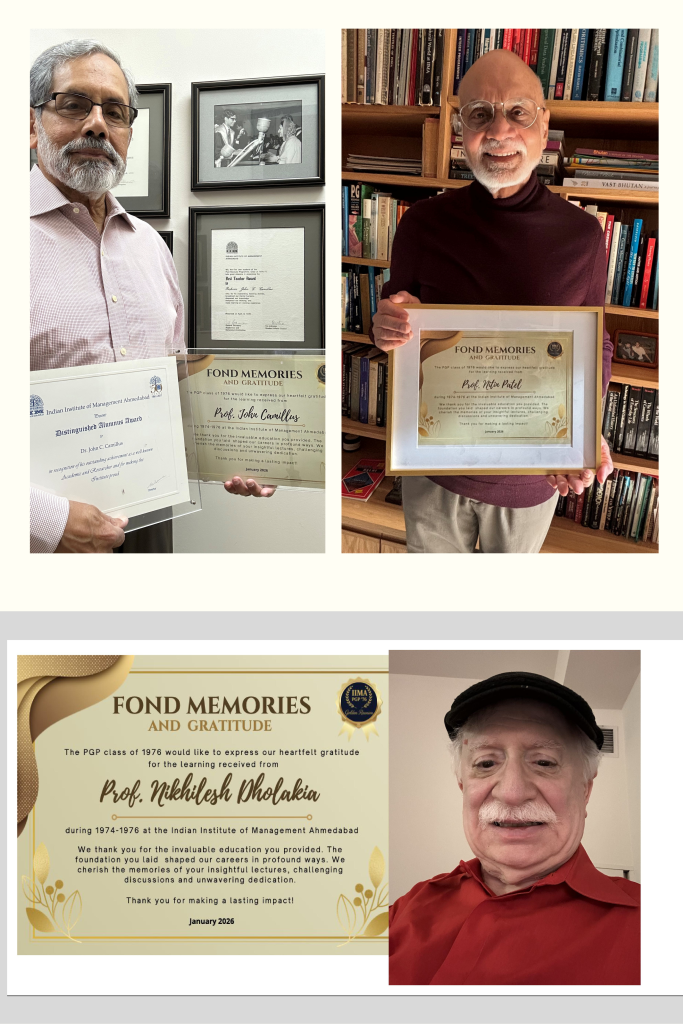
A touching moment to recognise is that Prof Bhatnagar wished us for our Reunion just a few days before he moved on. Prof Camillus also shared his treasured photos of receiving the I Schol award from Ms Indira Gandhi during his graduation from the first batch of IIMA. Prof Wadhwa took the pains of recording a video to wish us the best for his reunion.
Finally, we reached out to the children and families of the faculty members no longer with us and mailed the memento to them. Among those remembered this way were 17 legends of the Institute:
- C Gopinath
- M.N. Vora
- S K Bhattacharyya
- N.R. Sheth
- Pramod Verma
- S.C. Kuchhal
- Dalip Swamy
- PM Shingi
- Samuel Paul
- Dhiraj K Desai
- G R Kulkarni
- Subhash Bhatnagar
- Dwijendra Tripathi
- Subhash Mehta
- Subroto Sengupta
- V R Gaikwad
- V S Vyas
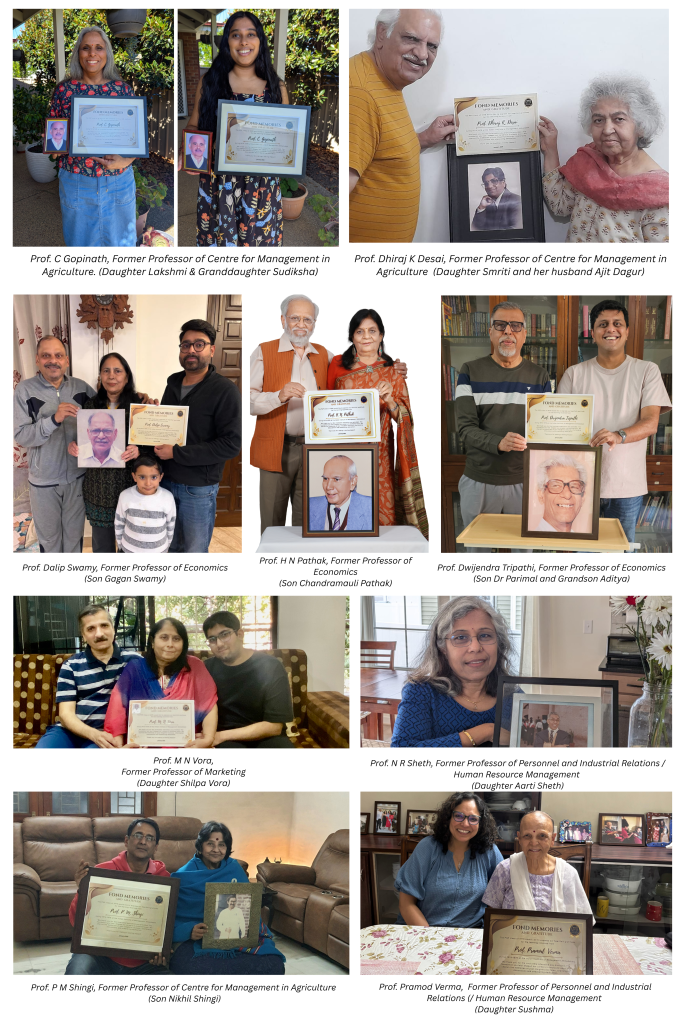
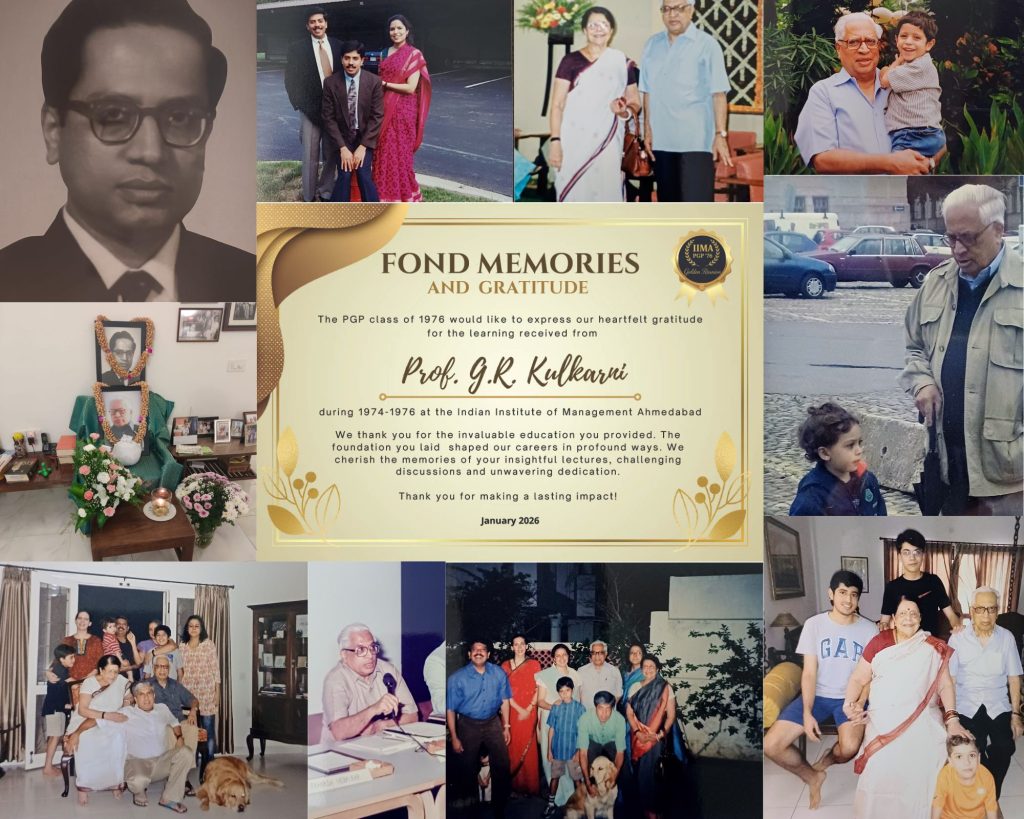
(Photo Collage credits: Srikrishna Kulkarni (Son))
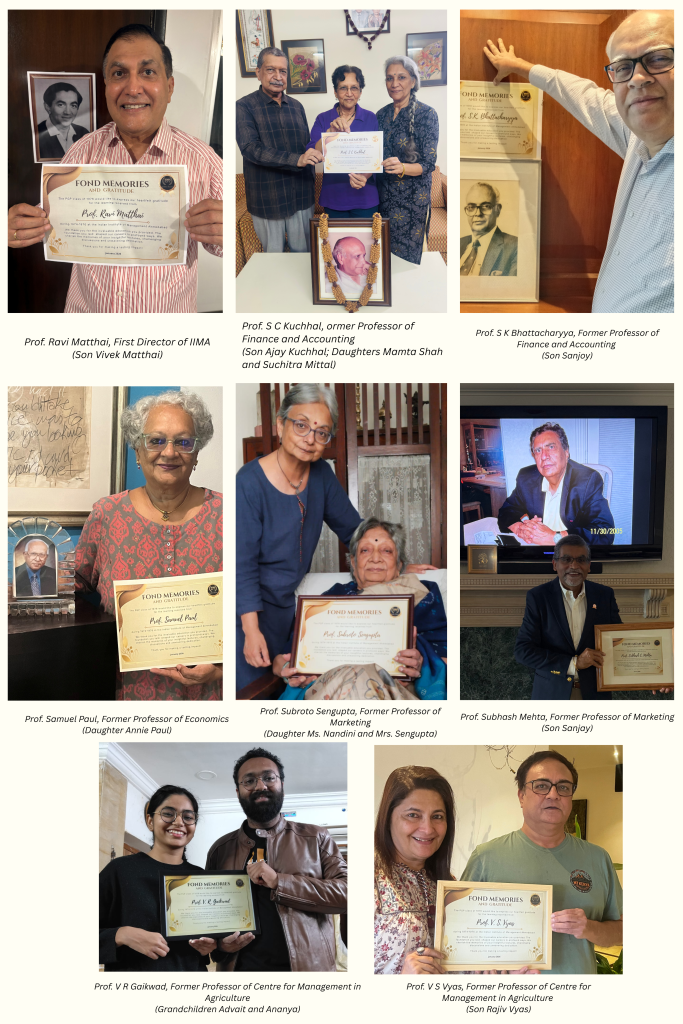
It was heartening to connect with the Bratpack, all of whom had many interesting stories and moments to share [some of which will always remain off the record] when they were on campus. Interestingly, we were able to connect Prof. Mampilly’s daughters with the daughter of Prof. Wadhwa, who met up [virtually] decades after losing contact, thanks to these efforts.
In summary, our batchmates contacted, and in most cases, visited a remarkable number of the faculty who taught us, and they were visibly moved by the gesture. Their spouses, receiving the honour on their loved ones’ behalf, were equally touched. And the children and grandchildren who received the mementoes were struck by one thing: that their parents were still being remembered, 50 long years after they had taught us.
And this painstakingly collected database of Faculty, their families and the contact details was handed over to IIMA Archives as their property.
None of this wonderful journey would have happened without the support of IIMA Director Prof Bharat Bhasker and Dean Prof Sunil Maheshwari, to whom our batch remains genuinely grateful, besides the ever-smiling Mr Pradosh and team from the Alumni and External Relations Office.
At the end of this twelve-month exercise, just one thought remains: Why don’t we remember our faculty, the people who actually made us who we are, a little more often?
Comments of Faculty and Family Members:
Prof. B. K. Hegde – [Comment from Deepak Hegde, son]
We are the family of the Late Prof. B. K. Hegde. I am his son, Deepak, with my sisters, Smitha and Savita, and our mother, Mrs. Indira Hegde. All of us have retired from our careers. I live in NJ, USA, and my sisters and mother live in Bengaluru.
Prof. Hegde was one of the core faculty trained at Harvard in 1963-64, and Chairman of the institute’s first PGP program. The first batches were not very large, and Prof. Hegde would regularly play tennis with them in the evenings.
He even invited students for dinner cooked by my mother. We have recordings of songs sung by some of these students at our home. Amongst the first batch of students was Prof. C. K. Prahlad, who was persuaded to join as faculty.
In fact, mom and dad were also signatories to his civil marriage when he decided to marry someone he met on campus. They also helped him settle down on campus when he returned from Harvard.
Prof. Labdhi Bhandari was also from the same batch. Others, such as Prof A. K. Jain and Prof. Jahar Saha, were amongst the first FPMs from the institute who joined as faculty.
Prof Hegde was amongst the first post-graduates from the country’s first IIT and amongst the very few engineers in the core faculty in the initial years. He was a consultant on several major public sector corporations such as HMT, HAL, BARC, and the Nashik Security Press.
He was therefore privy to some of the top security projects in BARC and HAL, including the decision to acquire Dassault Aircrafts in the backdrop of the Cold War and the vital decisions on the country’s fledgling nuclear program.
He also initiated the institute’s residential Management Development Program, which used to be conducted at a hotel in Agra as the facilities on campus were not ready then.
He died while teaching at the hotel in 1972 at the age of 42. It was a sudden and untimely death, like his mentor Dr. Sarabhai, and Dr. Homi Bhabha.
In an obituary to Prof. Hegde, Dr. C. Rangarajan stated that his death was a huge loss for the institute and professional management education in India.
He was so loved by the students that they pooled some money and instituted a scholarship in his name.
Prof. Subroto Sengupta [Comment from Nandini, daughter]
I am trying to think of anecdotes, but what I came up with is a mix of small memories –
I remember we lived in Bombay as it was known then from 1968 till about 1979. A couple of weekends every month my dad would go off to Ahmedabad to teach. Sometimes we accompanied him.
Before that he would prepare extensively for his class, even though he was teaching the same course year after year. He would carry a lot of paraphernalia with him to Ahmedabad, including posters in big cardboard rolIs, etc.
I asked him once why he went to so much trouble, and he replied that his students were too bright to fob off with old pre-prepared lectures, and he needed to stay on his toes!
Another thing I remember is that he would always walk around the room when he was teaching, unlike the traditional model of standing at the front and lecturing. He said it changed the mood (? culture?) in the classroom and made it more interactive, and he preferred it that way.

As I remember, he was a great fan of the Socratic method. But he was gentle about it, I believe (and hope!) – also a little unusual for teaching practices at the time.
All in all, he really believed in an interactive classroom, and valued students’ points of view and their input based on their experiences. He once mentioned that teaching was the biggest joy of his professional life. So this award would really be appreciated by him.
Hope this suffices. All the best for the reunion!
Prof. S.C. Bhatnagar
Dear Raman,
Thanks for your kind invite to be with your group to attend the PGP76 Golden reunion. I have also received the invite from the Dean Alumni Affairs. Your batch was the first batch that I had taught after joining the faculty at IIMA.
My wife Prof Deepti Bhatnagar, who had done her FPM at IIMA, and I had attended her PGP 73-75 batch reunion in December last year. The event was a lot of fun.
We, the faculty in 70s were blessed to have taught batches like yours who remember us even after fifty years and go to some length to express their gratitude.
Prof. T. V Rao
Golden Jubilee Reunion of 1976 batch.
It was such a great moment to be with the 1976 batch including Raman Nanda and team on January 2026.
It is difficult to recognise any one by face except a select handful i kept meeting during the last five decades.
Their preparations began almost a year in advance. Sometime in June 25 I got a letter from Dean Alumni to keep January 30 th free for the Golden Jubilee reunion of the 1976 batch.
After that almost every week one call from Raman to locate faculty who taught them or their family members.
The Alumni were eager to get to each one of the faculty and share a moment in person or virtually. They tried their best to get connected with the families of faculty and share their appreciation to their teachers living or dead.
It was a great and memorable event for me to be there and meet many old faculty colleagues like Sreekanth Sambrani, Jahar Saha, Bakul Dholakia, Indira Parikh, Sasi Misra. We were eagerly waiting to meet Mohan Kaul who could not make it last minute.
I was keen to meet Brian Pinto and Subbu who worked in Jawaja but was disappointed not to have them join us.
I was very pleasantly surprised to find several of them have become authors of books and were even gifting their books at the event.
Most interesting thing to learn about the batch is their giving back to the society at working level or the social causes.
This is the first batch of Golden jubilee reunion that I attended. Very nostalgic and energising. It was a reunion also for almost a dozen of the faculty.