
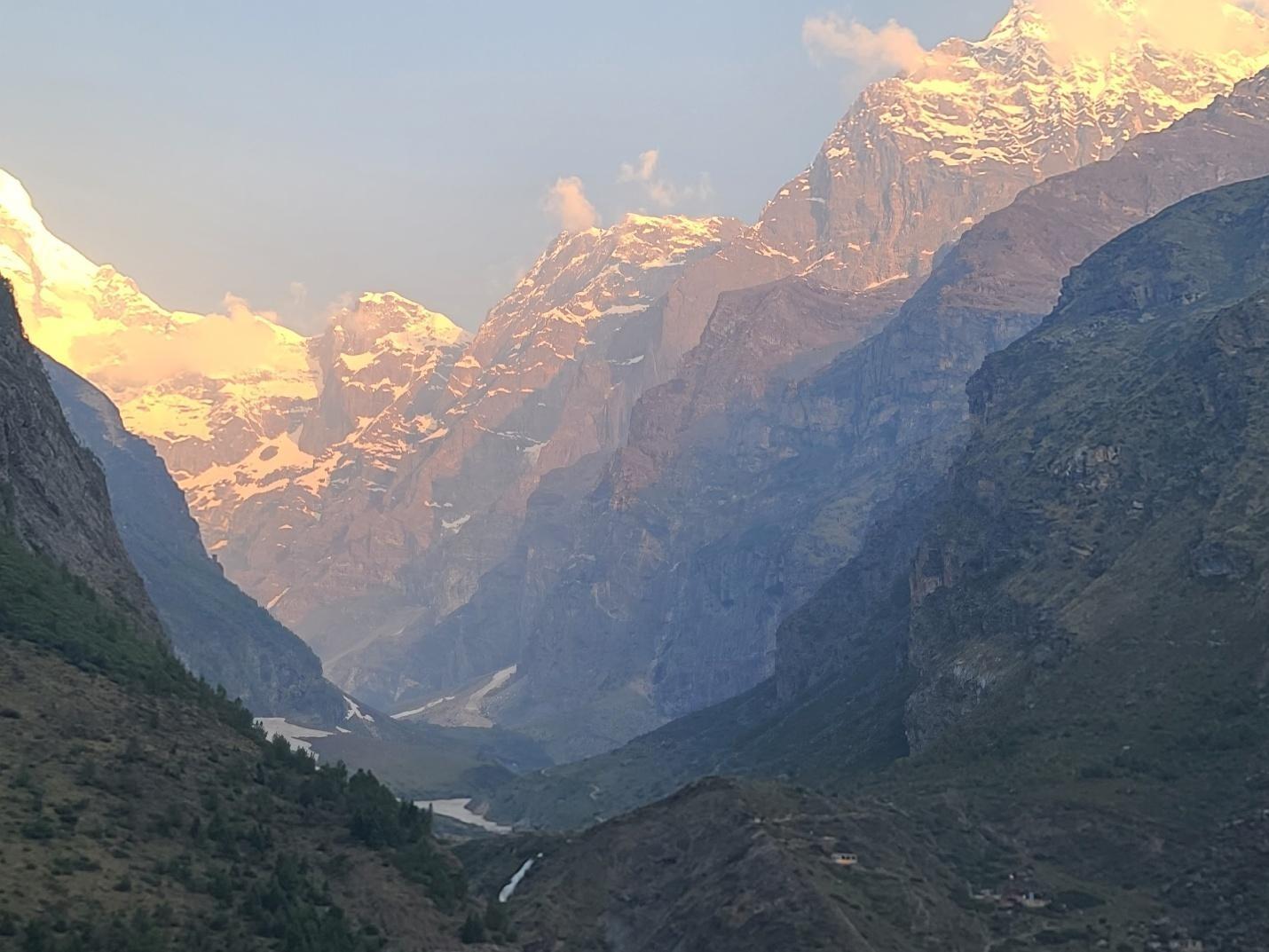
A vivid travelogue of the author’s week-long trekking trip to Uttarakhand
By Jay Namputhiripad, PGP 1994
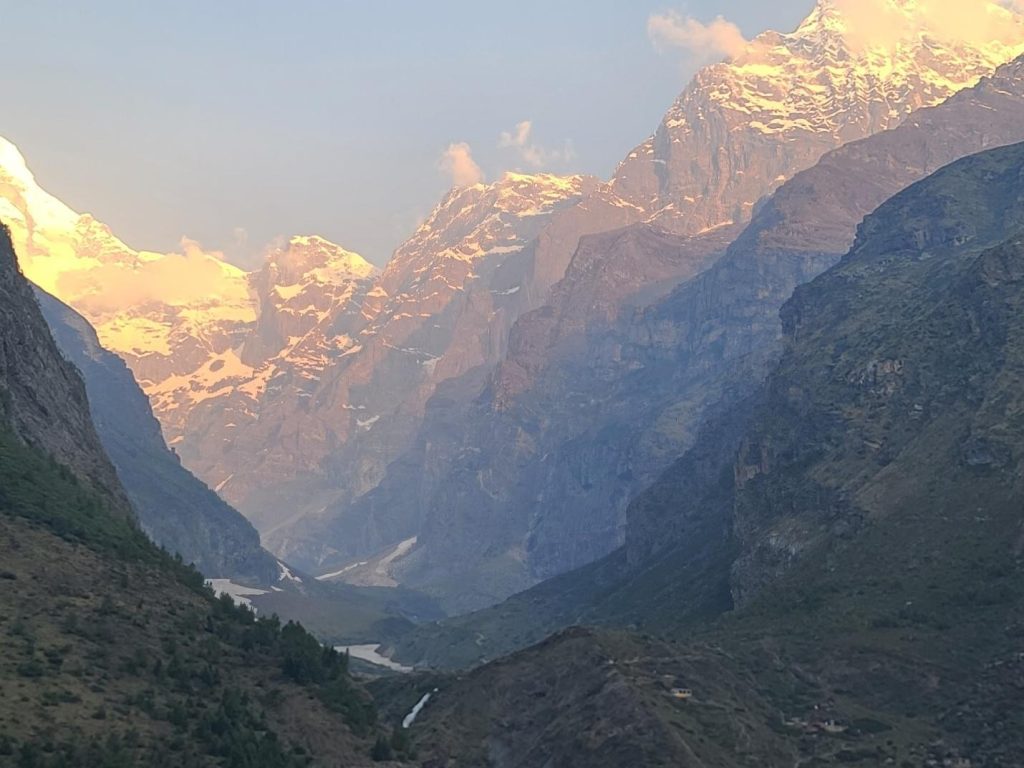
View of the snow-capped mountains at Badrinath
The flight from Trivandrum to Dehradun was uneventful. I was left to my own inchoate thoughts on what to expect, even as I was realizing a long-held dream of walking in the footsteps of the mighty gods who graced Dev Bhoomi. I had a connection in Bangalore, and as I waited, a gaggle of fifteen suddenly swarmed the gate. They were all wearing nylon cargo pants (with more pockets than buttons), moving with determination and urgency towards the gate. I picked up some excited chatter, about river rafting do’s and don’ts in Rishikesh and the best times to climb Adi Kailas. Another group arrived a little later. This was a saffron clad group of pilgrims, with ages ranging from 5 all the way to the eighties. I wasn’t quite sure which group I belonged to, but regardless, I was reassured of a “once in a lifetime” experience.
While Rishikesh is both the Yoga and Adventure capital of India, the state, Uttarakhand, bills itself as DevBhoomi for a reason. Almost every town, waterfall, forest, mountain or hillock in this state has some ancient (his)”story” or “god” story associated with it. Every confluence of two rivers is a Prayag with a 1000-year anecdote to support. I was fortunate to see Devprayag on the first day, about 45 miles from Rishikesh. It is where the brackish, sediment-laden yellow shoals of the Alaknanda merge with the impatient snow-fed crystal blue waters of the Bhagirathi, birthing the mighty Ganga. There were about 500 giant Deva-sized steps from the roadside to the confluence spot, and a swaying century-old suspension bridge to navigate, before I could dip in the cool new-born Ganga.
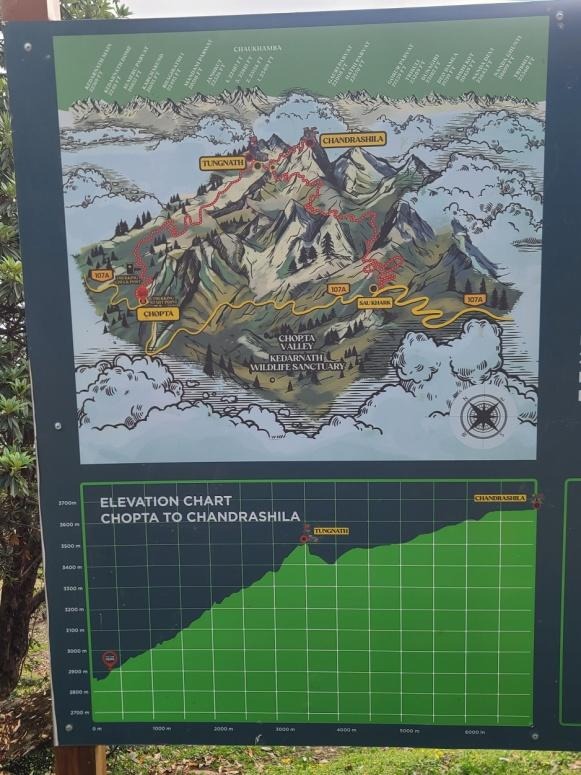
Trekking Map from Chopta to Chandrashila
I was driving from Rishikesh to Chopta, my first stop. Chopta bills itself as the Switzerland of India, and is just as beautiful. Pines, deodars, and rhododendrons dot the place, with snow clad peaks visible in the distance. However the facilities available are quite rudimentary. I was lucky to get a room in what looked like a furnished cargo container, plastered liberally with solar panels. Room rates ranged from Rs 17000 to Rs 25000 a day during peak season. Running hot water was provided by a small boy running with a bucket as needed. You yelled out to Chotu whenever you were hungry, and a makeshift kitchen would start up in the tent nearby.
All along the drive through the forested Himalayas, I saw itinerant holy men clad only in saffron dhoti, and angavastram, balancing their faith and all their worldly possessions on their head. They had no map to follow, no clock to watch. I saw some of them seated in natural caves amidst the lush forest, completely at peace. It is evident why the Himalayas are the soul of India. These beings showed no signs of distraction even as the loud whirl of helicopters punctuated the air, ferrying time-and-comfort bound pilgrims to Kedarnath within 9 minutes for “Instant Darshan”.
The next day I started the trek from Chopta Valley to Tungnath. Tungnath is famous as the highest Shiva Temple in the world, (higher even than Kedarnath). This was a fairly easy climb, taking less than 4 hours for an average hiker to climb the approx. 4000 meters to Chandrashila. (halfway to Mt Everest, I’d like to say!) Once you reach the temple it is a veritable smorgasbord of Himalayan peaks for the viewing: the Chaukhamba at 23000 feet, Nanda Devi and Nanda Ghunti at 22000 feet, the Trishuli and Bhagirathi at 24000 feet and many more on a clear day.
As I prepared to climb, I was taken aback at seeing group after group of tall well-built youth arriving at the foothills in rugged Jeeps. They all bore very macho demeanors and even more macho apparel. Imagine my surprise then, as almost all of them decided to be carried uphill on “dolis” by hardy Uttarakhandis half their size! It was an amazing sight to see these wiry men run uphill with 100 kilos of “customer” on their back. Some tourists preferred to go up on horseback, perched ungainly on their mounts that made their way uphill at an easy canter, randomly pausing to splatter the trail with excrement (the horses, not the riders). It was all I could do to avoid the mess on the trail, while taking care not to skid over the hundreds of empty plastic bottles strewn on the path.
The climb up was exhausting but exhilarating. It took me about 4 hours each way. There were hundreds of people climbing, in all kinds of attire and footwear. I felt embarrassed to be wearing hiking boots, when all around me, Pahadi men , women and children sprinted their way up in ordinary worn out chappals. Many walked barefoot, shod only in impermeable devotion, for the entire climb. Cattle grazed on terraced plateaus along the mountain, indifferent to the weather that constantly vacillated from hot to cold, sunny to rainy, cloudy to clear sky. Rain fell in clumps and the air progressively got cooler. The spiritual energy of the place is palpable when one enters the temple precincts at Tungnath. The deity is embodied in black stone that you can touch and venerate. Sometimes the line to enter the temple can stretch miles downhill, but I was lucky as I had started really early. There were barely 50 people between God and I on that day.
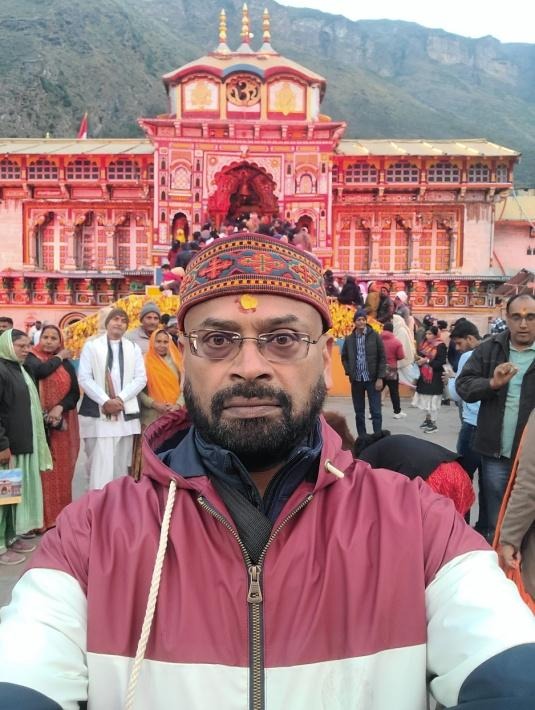
Author at Badrinath
The next day, I drove to Badrinath. The Badrinath Temple is located close to the Tibet border, on the banks of the Alaknanda River. If Tungnath has an austere beauty, Badrinath simply scintillates the senses with its mesmerizing earthly appeal. Legend has it that Lord Shiva resided here first, but Lord Vishnu loved it so much he displaced the prior resident 10 miles away to Kedarnath. The town packs up and leaves during winter, and the deity is taken to Jyotirmath for the next 6 months. Running hot water is not a problem for devotees, as there is a hot spring right at the entrance to the temple. It was 2 pm when I reached Badrinath after an 8 hour drive from Tungnath. Imagine my surprise when the line to enter the temple was a few thousand people long! I returned to my hotel for the night, resolving to try my luck the next day. I was up at 2:30 am, (thank goodness for jet lag), and had a quick dip in the Tapt Kund. I was in line at 3 am, with less than a 100 people ahead of me! This is an exotically beautiful temple. At 4 am, the black granite deity graces you with great majesty and serenity, set beneath dark starlit skies and a bright moon encircled by glacier and snow capped Himalayan peaks, with the Alaknanda gurgling beside. What an absolutely unforgettable and soul-satisfying experience!

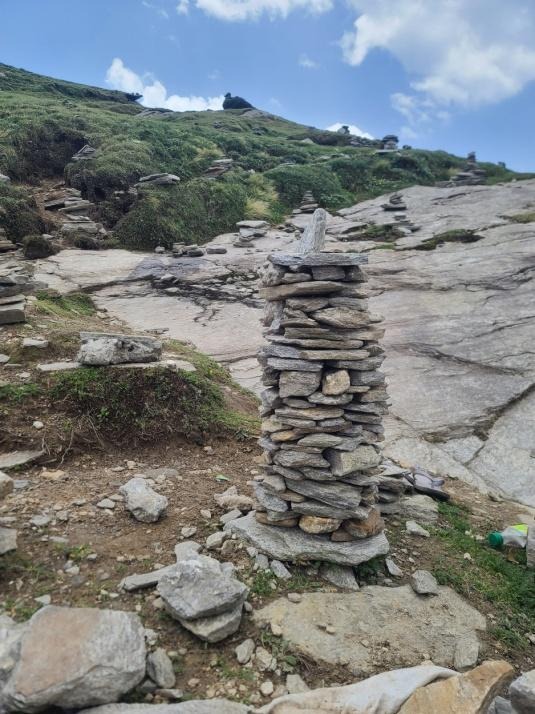
Prayer stones on the way to Tungnath
On the way back from Badrinath, I was fortunate to visit Mana, the last Indian village just before the border with Tibet. Mana is a very small village, where the populace makes a living by scratch-farming, carrying “doli” visitors uphill, by the pound, or selling cheap Chinese fabrics. I was fortunate to visit Veda Vyasa Guha that is about half a mile uphill, close to the border with Tibet, in Mana village. This is the cave that Veda Vyasa dictated the Mahabharata in, for Ganesha to scribe. A short distance away was the legendary origin of the Sarasvati river, marked with a small goddess figurine in stone. The river disappears underground here, a feat of engineering attributed to Balarama (of ploughshare expertise) in the Mahabharata. A large boulder was perched solidly across the water, supposedly Bhima’s makeshift bridge for Draupadi, when the Pandavas were ascending to Kailas. Somewhere between where I stood and Tibet, is where Draupadi and four of the Pandavas dropped dead, one after the other. I couldn’t help being overwhelmed.
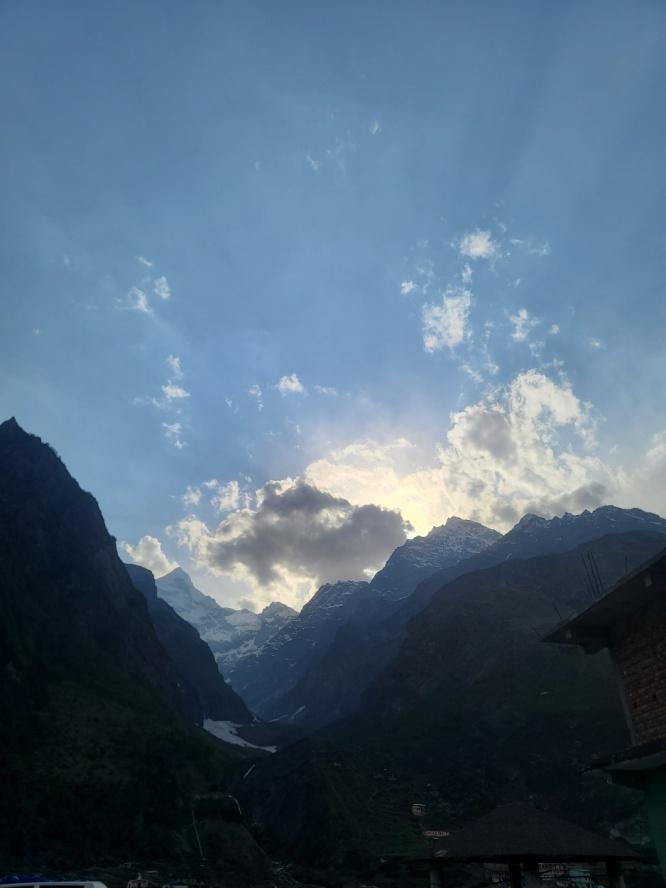
Interplay of Himalayan shadow and sun at Chopta, the “Switzerland of India”
I passed Jyotirmath, Rudraprayag, and Vishnuprayag, on the way back. Hemkund Sahib and the exotic Valley of Flowers beckoned 10 miles away. The pristine location of Koteshwar temple, on the banks of the Alaknanda river remains fresh in my mind. This is where Lord Shiva hid from the demon Bhasmasura in a cave. The stone boiled in the summer sun, and it was all I could do to dance bare-soled on the steps while simultaneously baring my soul. I returned to Rishikesh invigorated spiritually and physically. I must have clocked about 5 miles daily, most of it up and down mountains. It was time for a final dip in the Triveni Ghat at Rishikesh. Enterprising local children offered to swim out beyond the safety barricade and collect Ganga Jal for me in a plastic bottle. I had had enough enlightenment. It was time for me to get back to God’s Own Country, after spending a week with the Devas.
All the photos are by the author.
Jay Namputhiripad spent three decades spotting what could go wrong in banking, so others could focus on doing the right things. He now helps banks uncover where risks and problems hide—so their teams don’t have to. He has called Washington DC home for the last 25 years, and likes wandering across the world.