By Dr. Shiv P. Joshi, FDP 2024
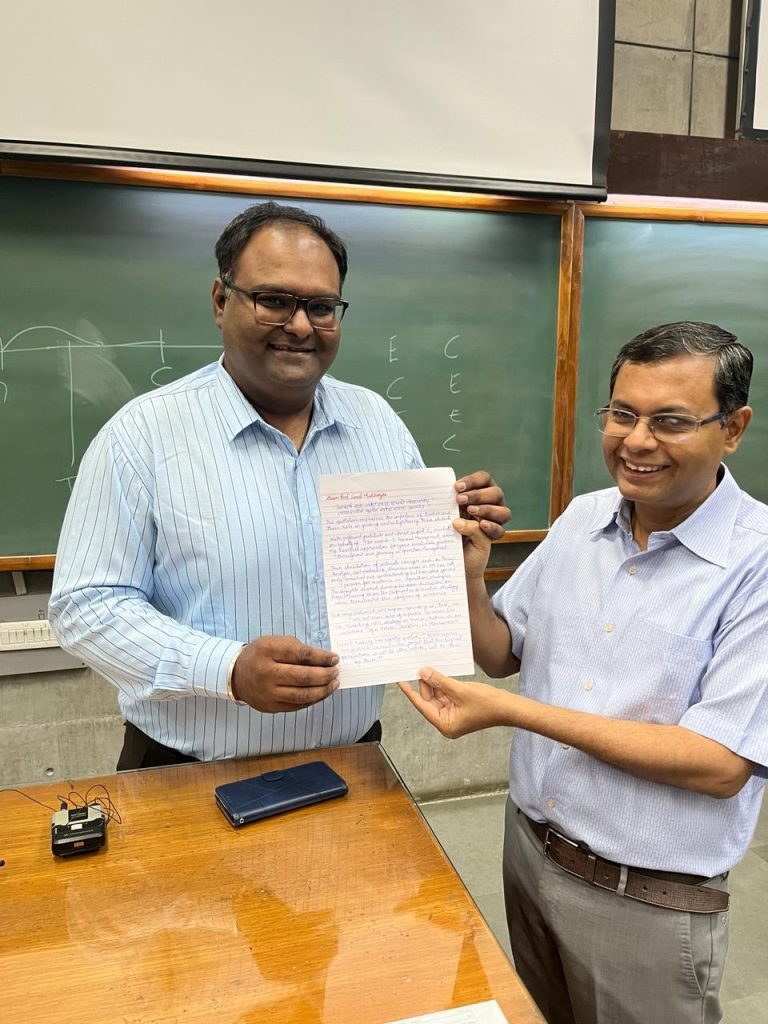
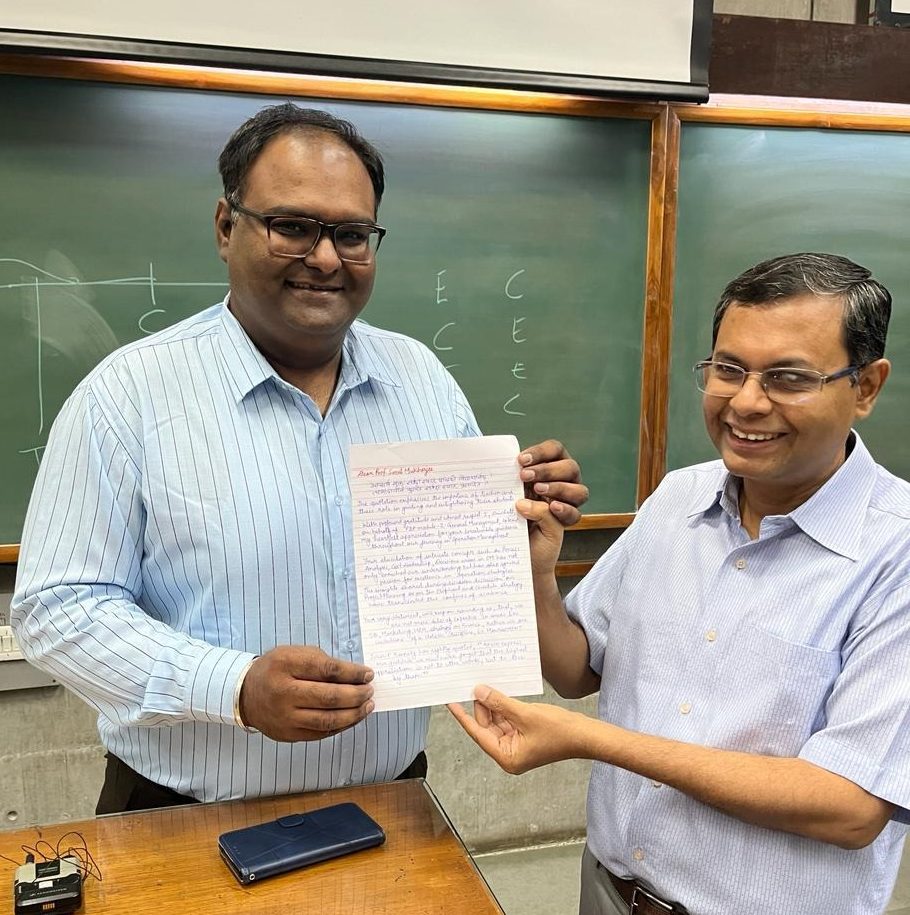
The author (left) presents a note of gratitude on behalf of his batch to Prof. Saral Mukherjee.
During my Faculty Development Programme – General Management at the Indian Institute of Management Ahmedabad in 2024, I had the privilege of attending a course on Operations Management conducted by Prof. Saral Mukherjee. His influence on my academic and intellectual orientation has been profound and enduring.
Prior to the commencement of the sessions, we were given a copy of his book “Elephants and Cheetahs: The beauty of operations”. I was eager to understand how this metaphor—intriguing in its own right—would be contextualised within the course. From the very first session, Prof. Mukherjee’s teaching approach was nothing short of exceptional. He began not with abstract theory, but with engagement—drawing every participant into the core of the discussion. The classroom transformed from a space of passive listening to one of active intellectual exploration.
The metaphor of the “Elephant and the Cheetah” was introduced not merely as a catchy title, but as a strategic framework. Through vivid illustrations and practical examples, he conveyed that organisations, depending on their scale, structure, and market dynamics, must oscillate between being elephants—stable, process-driven, and resilient—and cheetahs—agile, adaptive, and fast. He emphasised that strategy is not about choosing one over the other, but understanding when to be what.
Equally transformative was his perspective on bottlenecks. Contrary to the conventional desire to eliminate constraints, Prof. Mukherjee asserted that bottlenecks are inherent and necessary in any system. The true managerial insight lies not in denying their existence, but in identifying them and working relentlessly to address them. This shift in thinking—to see constraints as strategic opportunities rather than operational hindrances—left a deep mark on my approach to problem-solving, both professionally and personally.
His thought process challenged me to reframe how I view complexity, uncertainty, and limitations. What I earlier perceived as obstacles, I now interpret as focal points for innovation and strategic clarity. This intellectual transformation is something I carry forward in every leadership or academic decision I make.
Reflecting on this experience, I often find myself recalling the lines of John Donne:
“Lord, who am I that you are so mindful of me?” Such is the gratitude I feel towards having had the opportunity to learn from a mind as insightful as Prof. Saral Mukherjee’s. His mentorship, though brief in duration, has left a lifelong impression on the way I think, teach, and lead.
One particular memory that stands out vividly occurred towards the end of our FDP, during the certificate distribution ceremony. As we gathered to reflect on the enriching weeks spent at IIM Ahmedabad, I shared a light-hearted yet meaningful moment with my fellow participants and Prof. Saral Mukherjee—an incident that captured just how deeply his teachings had permeated my thinking.
Our FDP spanned nearly two months—53 to 55 days—away from home, from the comfort of routine, and most importantly, from our families. Being from Jodhpur, I was away from my wife and children during that time. Yet, while physically distant, I found myself carrying the discussions of the day beyond the classroom walls, often sharing reflections and insights during my evening calls with my wife.

One evening, amidst a routine conversation, my wife brought up a situation that had been troubling her. Naturally, she was looking for emotional support or perhaps a simple suggestion. But I was so immersed in Prof. Mukherjee’s class discussions that instead of offering a direct solution, I gently asked her, “Have you identified where the bottleneck is?”
There was a pause on the other end of the call—part surprise, part amusement. And in that moment, I realized how naturally the vocabulary and frameworks taught by Prof. Mukherjee had become a part of my everyday thought process. What began as a concept in an Operations Management classroom had quietly evolved into a lens through which I began interpreting real-life situations.
When I recounted this story during the closing ceremony, it sparked warm laughter, but also a shared understanding. It was a testament to how Prof. Mukherjee’s teaching transcended academic learning. His insights were not just applicable to business strategy but to life itself. That incident made me realize that the true power of education lies not just in knowledge gained, but in the transformation of perspective it brings—and Prof. Saral Mukherjee had done exactly that for me.
The author is currently working as Dean- Faculty of Management and Commerce at Jodhpur Institute of Engineering and Technology, Jodhpur, and an Alumnus of the 44th FDP in General Management at IIM, Ahmedabad. He can be reached at fdp24shivj@iima.ac.in