SOCIAL SECTOR/ PUBLIC SERVICE

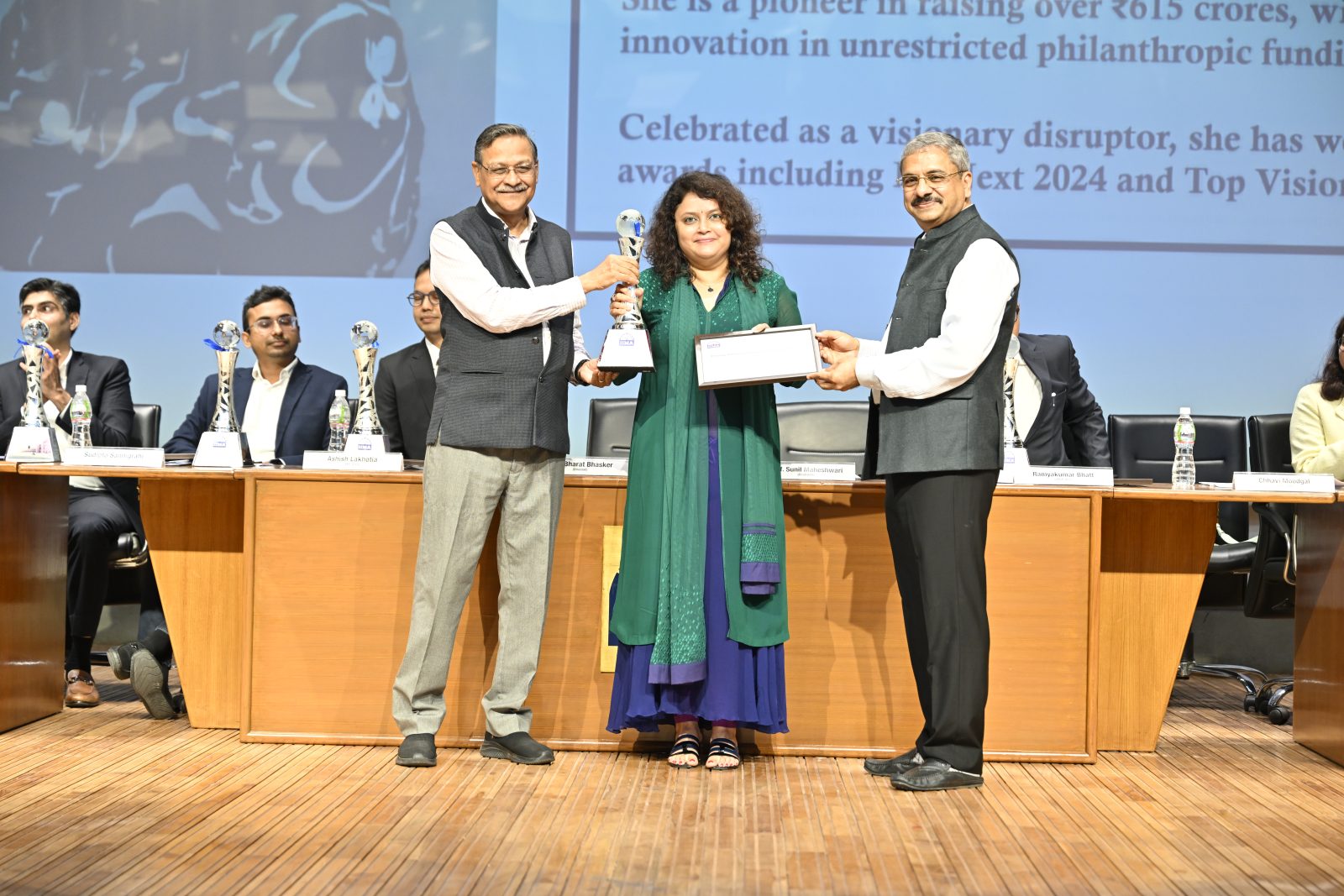
Chhavi Moodgal has spent over 20 years in the financial services industry – across investment banking, asset management, entrepreneurship and fundraising through endowment. She is currently the Founding CEO of IIMA Endowment Fund (IIMAEF) where she has played a pivotal role in solidifying the Institute’s standing in thought leadership, research, and academic excellence on a global scale. Before joining IIMAEF, she worked with the InCred Group, Scient Capital, Standard Chartered Bank, UBS and Kotak Mahindra Bank.
In her capacity as the Founding CEO of IIMAEF, Ms Moodgal has been a driving force in advancing IIMA’s vision by raising funds through philanthropic contributions from alumni, corporates and multilateral agencies. The IIMAEF through her leadership has raised nearly twice the funds raised in the history of IIMA within a short span of four years. The total commitments managed by IIMAEF are in excess of 615 crores with over two thirds of the funds being unrestricted funds, giving the Institute flexibility to deploy funds as per its priorities. This is in stark comparison to other Indian academic institutions where over 90% funds are raised as proposed donations – through naming rights. This exemplifies true innovation in marketing and outreach at IIMAEF.
Ms Moodgal’s leadership and market-shaping contributions have won her and IIMAEF multiple prestigious awards like the FinNext 2024 Award (Dubai), Great Indian Disruptive Woman Leader Award (2024), Great Indian Change Maker of the Year Award (2024) among others, recognizing her as a visionary disruptor in the institutional philanthropy and education space.
Ms Moodgal has a degree in Economics (Hons) from Lady Shri Ram College of Delhi (Gold Medal in 2000) and an MBA from IIM Ahmedabad (PGP 2004).
Congratulations Chhavi, on winning the award. How does it feel to receive this recognition?
First of all, you said Young Alumni Achiever’s Award, and then you said 20 years of experience, so that in itself made me feel young. So thank you so much for that. This award is extremely special to me. I know a lot of people, including senior alums who got this award in the past, and each of them has been an amazing achiever in their own right. But what is most gratifying for me is that it’s actually the recognition of my work for IIM Ahmedabad. The category for which I won is really in the social sector. This big pivot, which I did from more mainstream financial services to the impact sector, I wasn’t sure how successful that would be. So I had all the right intent, and I had a lot of support, from the institute, from our board, from the endowment founders and the alumni office, and from the faculty. But to make a dream real, one never knew the extent of success one could achieve in it. So life has kind of come back a full circle, and after being a student here and now winning this award in recognition of the work that serves the alma mater, it is very gratifying.
Look at Oxford and Cambridge. They have lasted for 1000 years and also the US schools such as Harvard and Stanford have lasted for 100 plus years. So IIMA is very young. And I think what we wanted is to create a sustainable platform which enables longevity of this institute, and future growth can only come when there is a capital, but also collaborations.
IIMA endowment fund is the first of its kind in an Indian Management School. So what inspired you to take on this challenging role of setting up the endowment?
So you know, the IIT, even some other educational institutes, were actually systematically raising funds, even IIMA, when Professor Ashish Nanda was the director, there was some giving back. At that time, there was a development office, so there was some culture of giving. But I think the true blue endowment, in the sense that we understand it, and the numbers which we see for global universities like Harvard, Stanford, are like billions of dollars. I think that kind of ecosystem wasn’t really there. These things are just absolutely massive globally. Being in finance, I had a lot of exposure to them. In fact, some of the CEOs and CIOs for endowments are really innovative and not just on the fundraising side. It’s also actually on the asset management side, because the endowment gets invested as well.
Secondly, in this case, there was a lot of gratitude to IIM Ahmedabad for doing it. So if there should be an IIM that has to do this, it, of course, has to be IIM Ahmedabad, which is consistently ranked number one. But more importantly, it’s my alma mater. Professionally, IIMA gave me so much. Also, personally, many people know this– I met my husband on campus. So my life just transformed completely due to IIMA. If there is one Institute to do it for, it’s your own alma mater.
The third thing is that when you look at the history of academic institutes in India, like we were at the forefront, with Nalanda and Takshashila, and they lasted for so many years. And one of the reasons that they lasted as long as they did is because they had a reserve to dip into. Reserves are useful, if there are shocks. For example, if fees change for whatever reason, for academic institutes, there are only two large sources of actual corpus building. One is these endowments which are coming from philanthropic contributions. And one is, of course, the surplus which the institute generates on its operations, which is largely free income from different types of programmes or products. Even in Nalanda, Takshashila, one third to half was actually coming from donations, even at that time. Look at Oxford and Cambridge. They have lasted for 1000 years and also the US schools such as Harvard and Stanford have lasted for 100 plus years. So IIMA is very young. And I think what we wanted is to create a sustainable platform which enables longevity of this institute, and future growth can only come when there is a capital, but also collaborations. So endowment is also about the intangible value of the network or the ecosystem that one is creating. So I think all of that, to me, was really exciting.
Personally, it also leveraged the same skill sets of fundraising, senior stakeholder management, looking at it from a very good governance perspective that I was used to, even from my formative investment banking days, so it was leveraging the same skills, but with a very different hat. And there were some wonderful people–the founders of the endowment, who conceived this in discussion with the board of IIMA, the Director and Dean, and all the senior faculty. So this journey is not a one-person show at all, and it wouldn’t have started without that support. But you always need a catalyst and someone to just help put it all together from an operating perspective. So the founding CEO role was just unique, and very grateful that I took it and got it.

How do you approach engaging IIM, diverse alumni, faculty, corporates and other stakeholders and bringing them on the same page?
So it’s not always a financial contribution. It can also be in terms of time. But basically, it’s not just engagement for the sake of engagement over time; it should ideally lead to some ways in which the alumni or the corporate is thinking about contributing back to the alma mater.
As I said, like there’s no real playbook for environments before, but if someone were to learn top-class stakeholder management and negotiations, “Please come work with us, honestly”. Look, the Alumni Office and the Institute are doing so many formats of engagement anyway. You all engage with alumni in different sets of ways, but I think over here, the endowment mandate is eventually it should lead to either fundraising or some kind of collaboration that is useful to the Institute. Sometimes, we are even getting people to write cases or come as guests, faculty, etc. So it’s not always a financial contribution. It can also be in terms of time. But basically, it’s not just engagement for the sake of engagement over time; it should ideally lead to some ways in which the alumni or the corporate is thinking about contributing back to the alma mater. Since we are dealing with the best of the best, it’s always high pressure, because some of our alums are the most responsive and they want clarity on everything, etc. So we had to just change our style of being extremely responsive first. And it wasn’t a clean slate because they were used to dealing with the Institute in a certain way in the past. So we just tried to change it a bit and be extremely available on WhatsApp, not as much, only on emails, and just engage with them. The second was hyper-customisation. So, in a major gift category, because every individual is so unique, when you approach them, you have to find ways of connecting with them. So with Deep [Kalra], you talk about travel, with Sanjeev [Bikhchandani], you talk about what he has done for entrepreneurship. With someone else, it could be about their kids. It could be about their favorite product. We do a lot of research before we reach people. With corporates, it’s different, because you have to align with their CSR vision, what their strategy is, what area they are interested in, and so on and so forth. If it’s a batch, then largely, you have to appeal as a collective to them. So you have to talk, the reunions, which, of course, the Alumni Office helps us in so much, but we meet all of them and try to just give them a greater vision of where the institute is going and how all of them can join that journey.
So I think that’s hyper-customisation, and then adapting it to these different sets of donors is the second thing. And then the third thing is stewardship. A lot of people had even given money in the past, for example, some of them may or may not know where that money was used, or what happened. So we work very closely with the finance team of IIMA, and then if it’s a Centre of Excellence, we will work very closely with that Centre. If it’s a shareholder, then we work with that faculty. But we do try to keep all donors updated. And this is not just about the donors, who came after the endowment was set up, even all the past legacy donors, to the extent we can connect with them every year, we will send them periodic updates. We will do periodic events to engage with them. So you are almost creating a new vocabulary of giving, endowments, vision, engagement, which I think was not really done in that manner, as much or as systematically. Before, there were a lot of seeds that were sown in early signs of success, but I think we’ve just built upon it with a lot of professionalism and very systematically.
Watch on YouTube: https://youtu.be/Phv_ta8NfeQ?si=PuB9K0sdS13DZvn0