By V. Venkata Rao,
Retired Professor, Information Systems Area
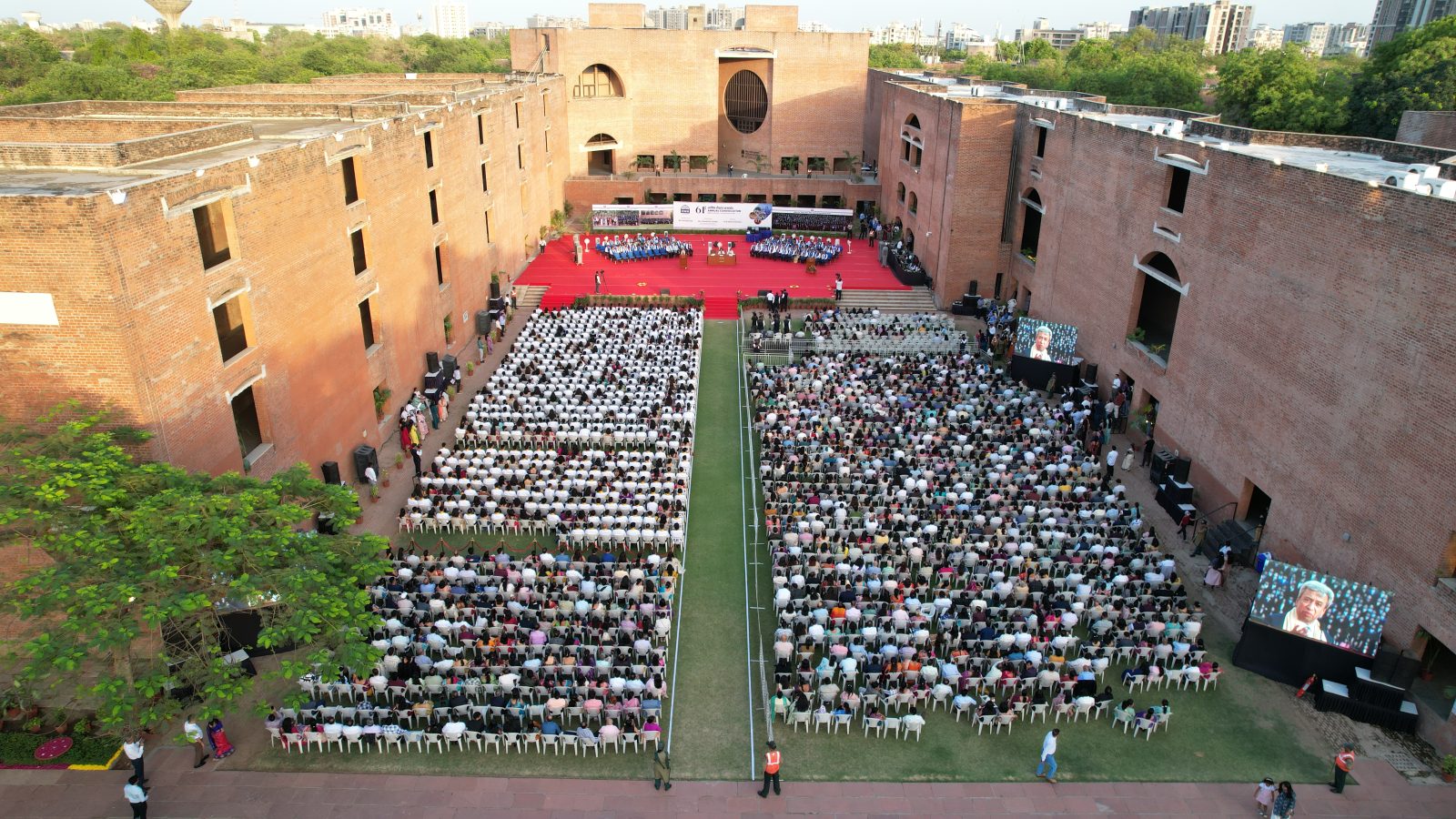
I attended the Sixty-First Convocation of IIMA on 28th March 2026 at the Louis Kahn Plaza (LKP) and enjoyed every moment of the ceremony. In fact, since joining the IIMA faculty in July 1981, I have attended in person every convocation of IIMA, missing only the two virtual ones during the COVID-19 pandemic. Sitting through the latest convocation, I let my memories drift back to the 1980s and 90s, tracing how the convocation traditions have transformed over the years. Obviously, several changes—big and small—have taken place. These were necessitated by the IIM Act, the increased scale of the event, and advancements in videography and the Internet. Yet, despite the changes in the procedures, I’m delighted that the event fully retains its spirit of achievement and solemn grandeur.
The IIM Act granted all the IIMs degree-awarding powers, and, unfortunately, stripped the IIMA society of its earlier status. Consequently, the present-day convocation confers degrees, not diplomas. Further, the degrees are conferred on the candidates with the permission of the Board of Governors (BOG) and not with the permission of the IIMA Society. Accordingly, the chairman’s script is modified from
“Members of the society, may I confer the diploma on these candidates?” to
“Members of the Board of Governors, may I confer the degree on these candidates?”
The number of programs involved in the current convocation is four:
Doctoral Program in Management, Full-time two-year Post Graduate Programme in Management, Full-time two-year Post Graduate Programme in Food and Agri Business Management, and Full-time one-year Post Graduate Programme in Management; the graduates of these programmes get the degrees Doctor of Philosophy, Master of Business Administration, Master of Business Administration in Food and Agribusiness Management, and Master of Business Administration, respectively.
The total number of graduating candidates in the 1990s was around 200, whereas the number shot to 629 in the 2026 convocation.
Because of the increase in scale, the duration of the convocation has increased. The latest convocation took two hours and forty minutes from start to finish, out of which the award of the degrees took one hour and forty minutes.
Even though the number of candidates receiving the degrees has roughly tripled during the last three decades, the time taken for the degree-awarding phase has only doubled. This is undoubtedly due to improvements in process efficiency.
The entire sequence of steps constituting the process is orchestrated such that a candidate takes approximately ten seconds from the moment her/his name is called to the moment she/he starts leaving the stage.
Such a short cycle time is achieved by fine-tuning and synchronising the following five activities:
- The program chair reads a candidate’s name,
- The candidate who is already at the head of the queue on the stage reaches the chairman of the Board of Governors in about ten steps,
- The office staff pick up the certificate from the top of the stack kept behind the dignitaries on the stage, and pass it on to the chairman of BOG, just one or two seconds before the candidate reaches him,
- The candidate and the chairman jointly hold the folder open for the photograph,
- As the candidate leaves the stage after the click of the camera, the name of the next candidate is read.
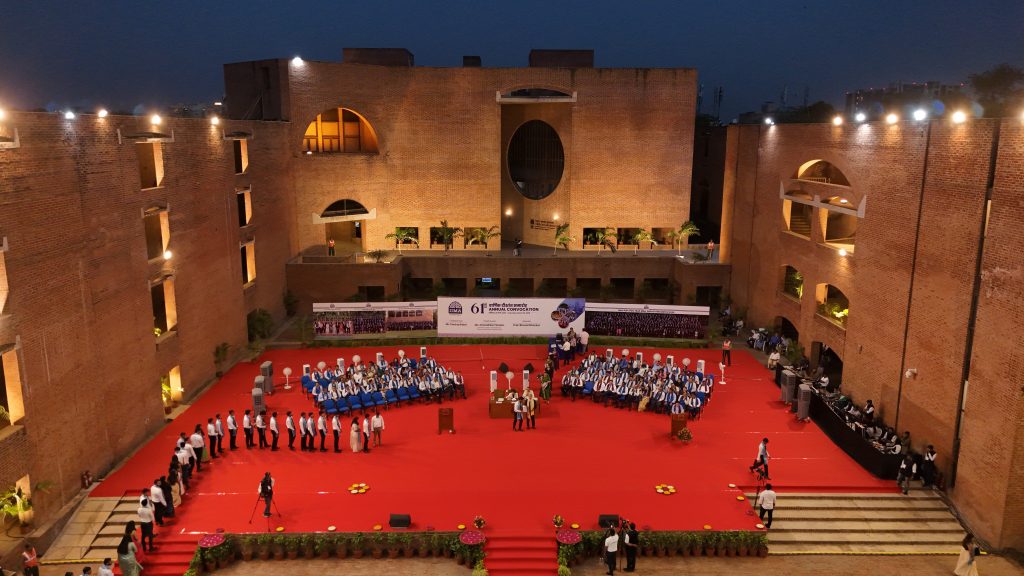
In the latest convocation, the above steps were so well timed and rehearsed that the whole process worked like a fully automated assembly line. All the activities were performed briskly, but at a steady and safe pace.
An ill-designed process, on the other hand, would have led to many untoward incidents: candidates rushing towards the chairperson would have tripped on the stage, or photographs meant to show a single candidate holding her/his certificate with the chairman would have captured the next or previous candidate also.
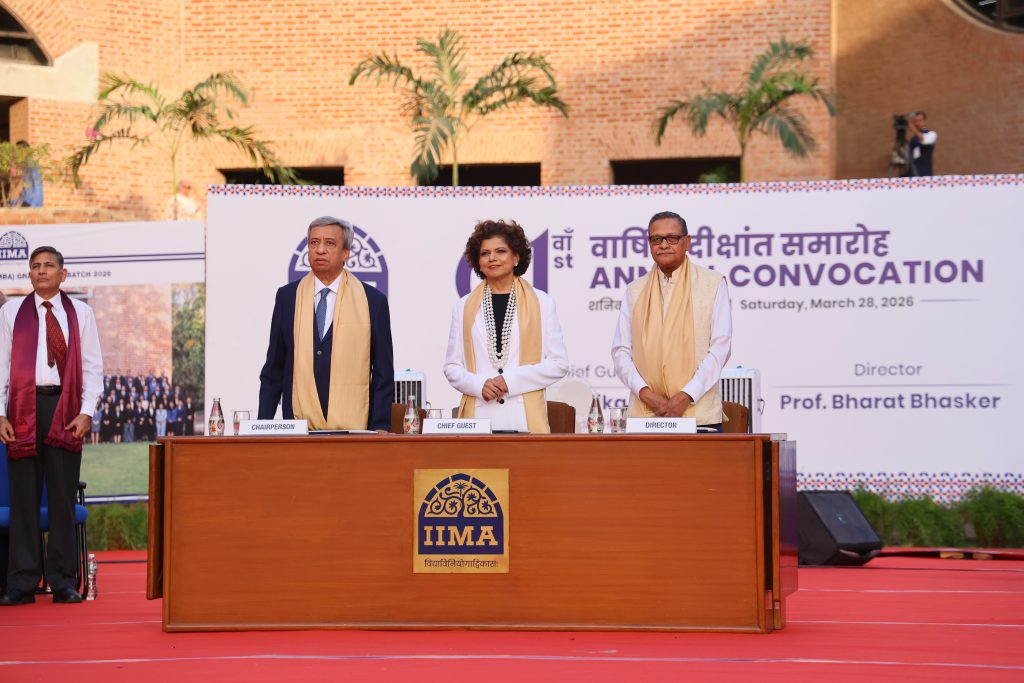
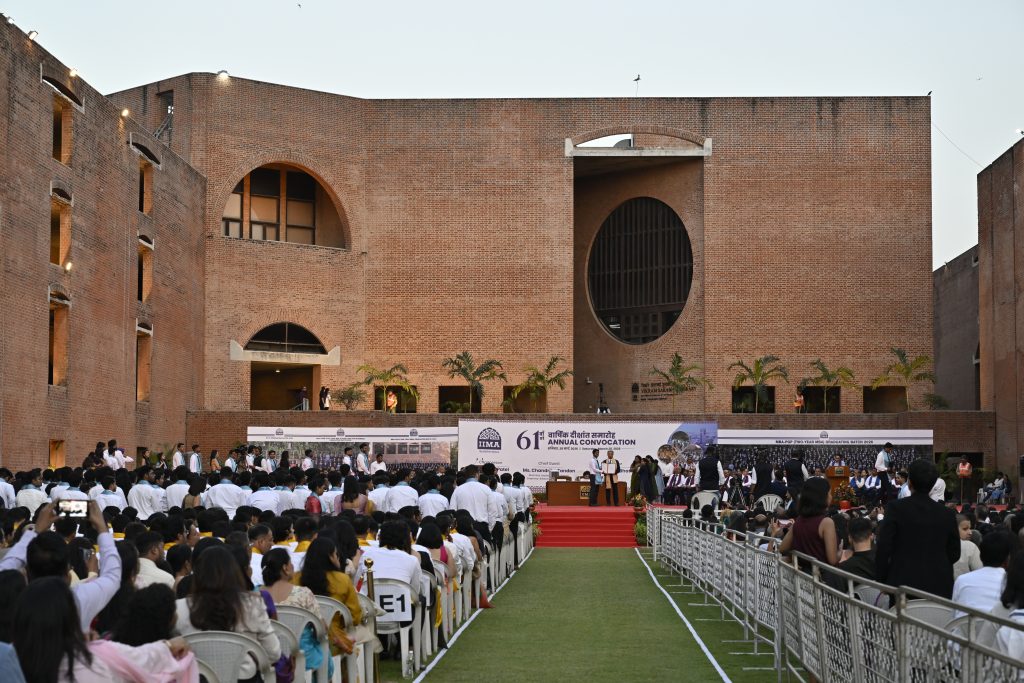
Mrs. Chandrika Tandon (PGP 1975), Chief Guest; and Prof. Bharat Bhasker, Director, IIMA, on the dais during the 61st Annual Convocation.
The person most stressed because of the large scale of the convocation is the chairperson of the BOG. Even for a younger person, it is no easy task to hand over 620-degree certificates and strike a pose for the camera just as many times, while standing on his feet for over two hours. Fortunately, the earlier practice of the chairman shaking hands with every candidate is now done away with; otherwise, the chairman’s hand would get frozen in the handshake position for a couple of days, during which time he would have to walk around continuously with an extended hand.
There is a major change in the convocation costume. The age-old gowns are now replaced by stoles, with different colours for different programs. This must be welcome for both the participants and the organizers. The gowns were unwieldy and uncomfortable to wear, especially in hot weather. Worse, the gown made its wearer look like a vampire. Further, the organizers had to allocate special areas to facilitate the robing process, and had to ensure that the gowns were issued and taken back properly.
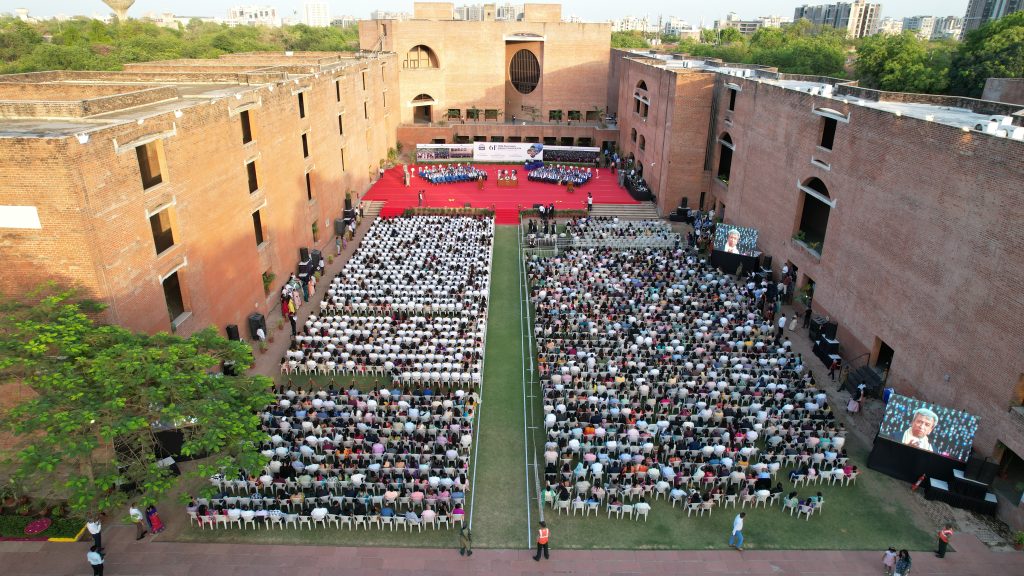
The venue for the main event remains to be the LKP. Despite its gradual dilapidation, the Plaza– flanked by the erstwhile faculty wings and the row of classrooms– continues to inspire awe. The elaborate lighting and other decoration impart a cheerful and festive look to the venue, but cannot fully mask the patches of decay on the surrounding walls. However, the restored Vikram Sarabhai Library, looming large behind the Plaza, looks as magnificent as ever, and intensifies the academic aura of the event.
Thanks to modern large-format digital printing, huge group photographs of candidates are produced and erected behind the stage, forming an impressive backdrop.
If I am not mistaken, for over forty-five years, the same central staircase and STOP sign have been used in every convocation. It is remarkable that this structure is removed at the end of each convocation, stored carefully for a whole year in an unknown location, and resurrected at the next convocation.
The venue of the convocation photograph with the chief guest has been shifted from the photo lawn to the cricket ground. The steps behind D-18 are obviously inadequate to accommodate all the people who are to appear in the group photograph. During the 1980s and early 90s, the group photo used to be taken by Mrs. Koti, a frail old lady with a pleasant but strict demeanour. Her ubiquitous presence on campus caused many to mistake her for a regular employee of the Institute. Fastidious in her pursuit of perfect pose, she constantly corrected her subjects’ posture, right up until the final click. She spared no one from her instructions, not even the chief guest, be it the Finance Minister or the Deputy Chairman of the Planning Commission.
In modern convocations, the entire proceedings are live-streamed on YouTube. The video of the sixty-first convocation, along with those of a few previous ones, is still available on YouTube. When the convocation is taking place, one can notice a drone continually flitting above the LKP, shooting aerial video. At times, it startles the guests by its jerky movements.
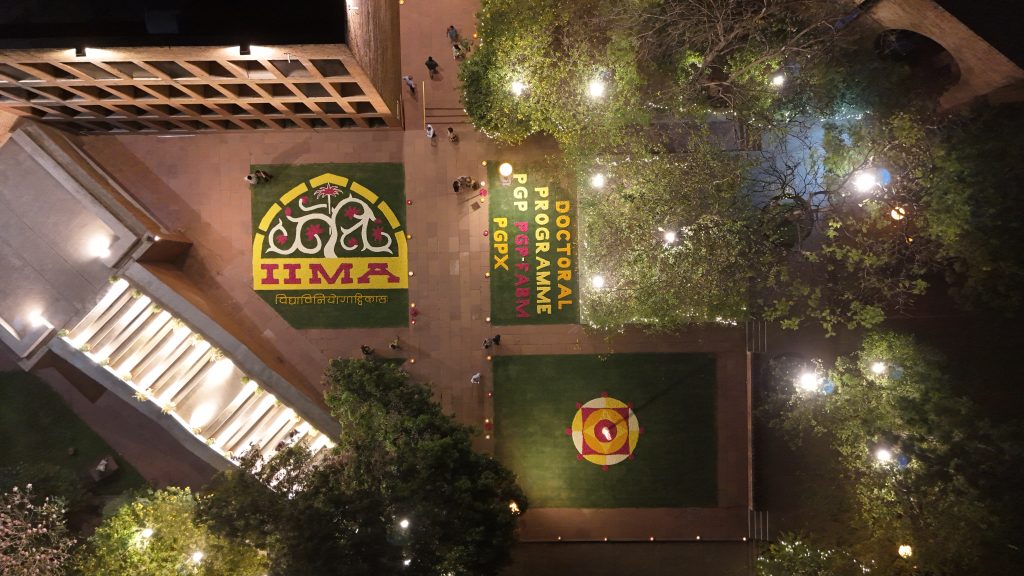
To repeat, what I like most about the ceremony is that everything in it goes like clockwork; the entire event is meticulously planned and executed–a testimony to the commitment of IIMA to process discipline, professionalism, and excellence. For the candidates receiving their degrees and for their relatives who are in attendance, it is definitely a joyous occasion and a once-in-a-lifetime experience. The sense of relief, achievement, and hope writ large on their faces rubs off on even guests like me.
Overall, the occasion never fails to evoke strong positive feelings among the attendees. Each time I attend it, I feel profoundly proud of my association with this fine institute.
May IIM Ahmedabad’s commitment to nurturing management leaders through its world-class programs continue to be unrivalled for many years to come.