
By Rajiv J Chaudhri, PGP 1980
Most conversations about Viksit Bharat 2047, India’s vision to be a developed nation by the 100th year of Independence, are heavy on macro-economic goals, like the aspirational $25 trillion economy, and the paramount role of government in infrastructure development, but they are shockingly light on basic micro-economic questions.
For example: What kinds of products and services will 2 billion Indians be producing and consuming so that the total value of their output and consumption adds up to $25 trillion?
The implicit answer is “everything that we are producing and consuming now, only 5X more”. This answer would also be wrong! God forbid if we are each consuming 5X more calories than right now! Or we are consuming 5X as much steel or cement. Economic development is not simply about consuming more of the same things. It is about consuming fundamentally different things – and creating fundamentally greater value.
Maslow’s hierarchy of needs provides some clues to the right answer. Maslow tells us that after physiological, safety, security, love, and belonging needs are satisfied, higher needs kick in–needs for the esteem of our fellow men and women, the desire for respect, status, recognition, power, freedom, and ultimately, self-actualization, which is the desire for creativity, self-expression, and experience of purpose and meaning.
A subsistence economy produces calories. An advanced, developed economy produces fine dining experiences.
An emerging economy wears handlooms. A developed economy wears high fashion.
These are specific examples of the more general idea that a developed economy is also a Creative Economy, where the main value propositions of goods and services are aesthetic and experiential, typically, but not always, with a significant advanced technology component attached. Industries in such an economy are based on creative ideas and imagination, research and development, innovation and intellectual property. Such industries are typically high value-added and command high profit margins, but are not easily susceptible to economies of scale, unlike traditional manufacturing or resource extraction.
The range of industrial sectors included in the Creative Economy spans (but is not limited to):
1) Traditional and modern artisanal crafts,
2) Art and culture (including visual and performing arts, and museums),
3) Media and entertainment (including film, television, music and publishing),
4) Design, encompassing fashion, graphic and product design, interior design, and architecture,
5) Digital content (including gaming, animation, app development, digital marketing),
6) Fine dining,
7) Professional sports, adventure, thrills, high-risk experiences,
8) Health, wellness, and longevity, and
9) Cultural heritage and tourism.
The Creative Economy represents India’s bridge from Make in India to Create in India.
All these industries turn creative skills into innovative goods and services that can generate income, jobs, and exports, which are critical to the goal of making India a middle-income country by 2047. By integrating creativity with technology and entrepreneurship, India can transition from a cost-based economy to a value-creation economy. The Creative Economy represents India’s bridge from Make in India to Create in India – driving sustainable, inclusive, and innovation-led growth.
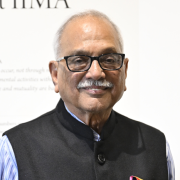
My batch, the PGP class of 1980, has suggested that IIMA explore the development of a range of case studies focused on the Creative Economy.
The plan to fund case work on the Creative Economy grew out of the PGP 1980 Art Project, which brought 10 large, custom-built artworks by tribal and folk artists to the IMDC Complex at the New Campus, IIMA.
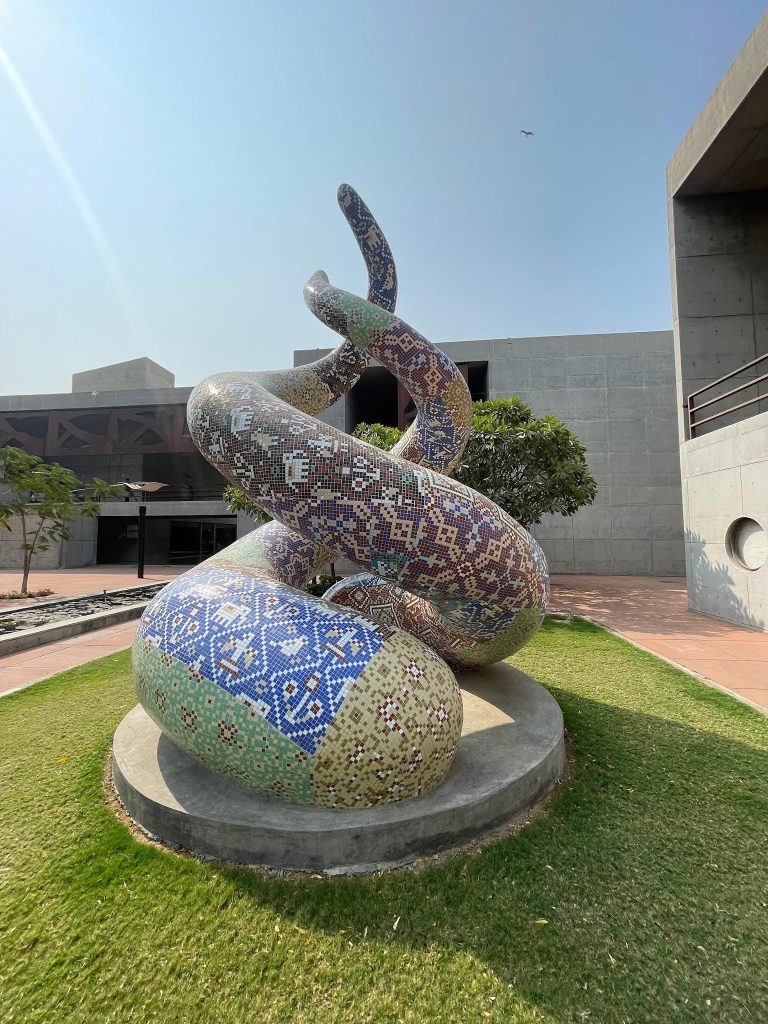
Our goal with the PGP1980 Art Project was to engage with IIMA around ideas that were large, original, and value-added. Beyond the artworks themselves, we hoped to draw attention to the important role that art and aesthetics can play at the Institute.
Being surrounded by art opens the students’ minds not only to aesthetics and culture, but also to a better understanding of the motivations that power the whole category of luxury and experiential goods and services that cater to the needs of esteem and self-actualization.
The study of art and creativity in an economic context, art as an upscale luxury business, art as an investment-asset class, art for tourism, etc., are all subjects worthy of study at IIMA. The PGP 1980 Art Project can serve as a starting point for conversations around these themes.
Art is also a social good
Art is also a social good. Art has the unique characteristic of being simultaneously appreciated, or “consumed” by the many – just like any commons – without the pleasure or “consumption” of one person interfering with the pleasure or consumption of another. The same artwork can be simultaneously and sequentially enjoyed by thousands, even millions of people. The cumulative social marginal utility that art delivers is immense relative to the cost of producing it.
India is systematically underinvesting in art and aesthetics because of a lack of understanding of this unique economic characteristic–its cumulative benefits are massive, even if they appear small because they are spread across many thousands of individuals, while its overall costs are small, even if they appear large because they are concentrated in single private hands.
The presence of art at IIMA and the potential for academic exploration of the Creative Economy connect to the larger question for Viksit Bharat 2047: how can India create greater value through creativity, innovation, and entrepreneurship? The PGP 1980 batch hopes its Art Project will encourage broader alumni engagement with these ideas. We invite others to join the conversation.